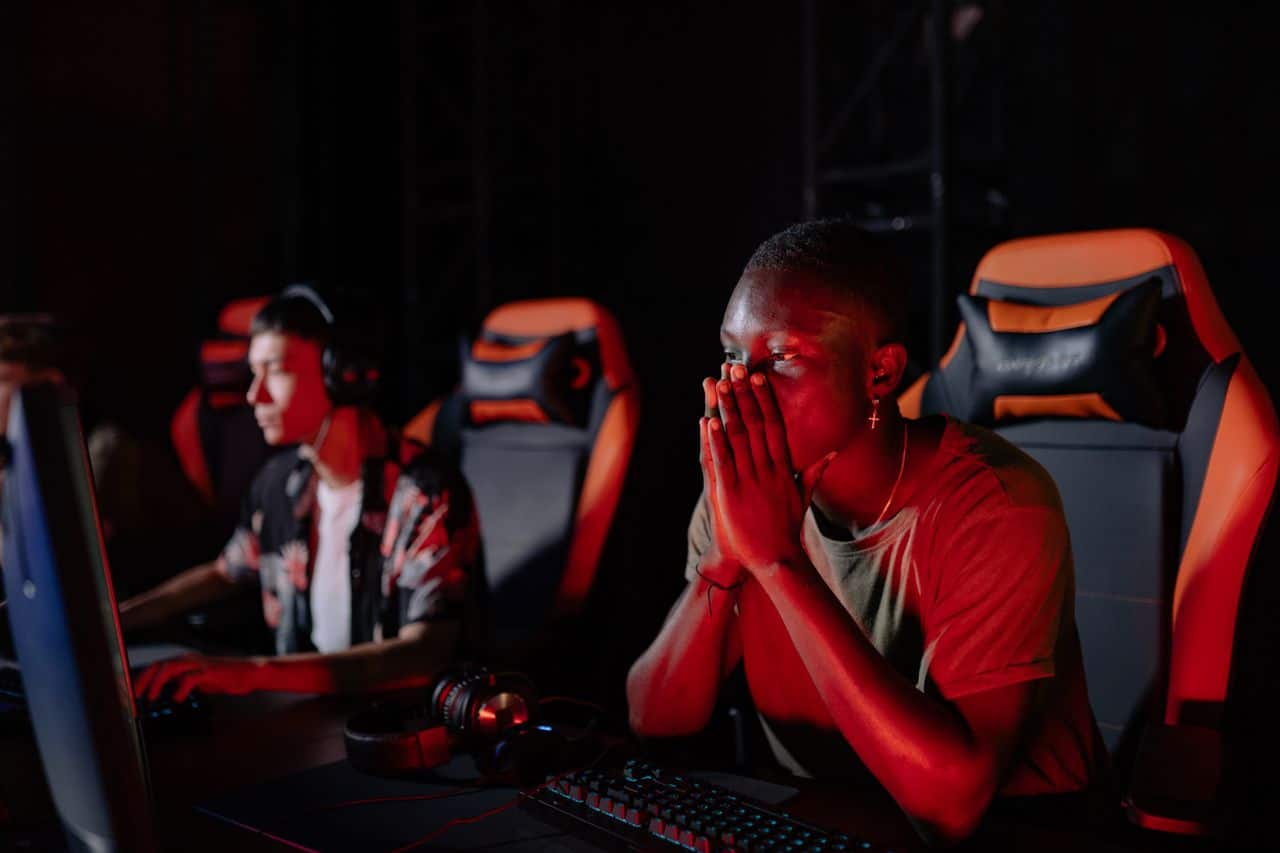
Esports burnout mirrors traditional athlete burnout through the same three-part pattern of exhaustion, reduced sense of accomplishment, and detachment from a game once loved, driven by unmanaged training loads, perfectionism, and identity fused with performance, and licensed therapists can help young gamers and their families build sustainable recovery and healthier boundaries around competition.
What if your gamer's late-night grinding isn't dedication, but a warning sign? Esports burnout mirrors athlete burnout almost exactly: exhaustion, numbness toward wins, and quiet detachment from a game once loved. Here's why that exhaustion is real, and what actually helps.
Esports burnout can look a lot like the burnout young athletes have long faced: exhaustion that sleep does not fix, wins that stop registering, and a flatness toward a game the player used to love. Competitive gaming also adds pressures of its own, and a player’s sense of self can get tangled up in rank. Here is how the pattern shows up, what can help, and where the evidence is still thin.
Why competitive gaming produces the same burnout shape as competitive sport
What is esports burnout and how does it affect young gamers?
Esports burnout affects young gamers the same way burnout has long affected young athletes: it wears a person down in three recognizable parts. The first is exhaustion, a tiredness that does not lift after a night’s sleep. The second is a drop in the sense of accomplishment, where wins stop registering as wins. The third is a flatness toward a game the person used to love, a quiet disinterest that can feel like betrayal of something that once felt like identity. This shape is not specific to any one sport or any one game. It shows up wherever a young person’s time, effort, and self-worth get organized around measurable performance.
That is the real link between esports and mental health and the much older conversation about competitive video games and mental health alongside traditional athletics: the demand structure, not the activity itself. A teenager grinding ranked matches late into the night is doing something structurally similar to a teenager running drills before school. VOD review, the practice of rewatching your own match footage to find mistakes, functions the way film study does for a football player. Scrims, the practice matches teams play against each other, carry the same weight as scrimmages on a field. Training blocks and ranked grinding sit in the same place a two-a-day practice schedule or a travel season sits for a young athlete, each one a repeated, evaluated cycle that ties a kid’s value to a result.
The comparison matters because sport psychology has spent decades building language, screening tools, and recovery approaches that esports has not yet developed on its own. Borrowing that framework gives coaches, parents, and players a vocabulary that already exists rather than one still being invented. Naming the overlap is not the same as saying esports and traditional sport are identical. Some differences are real and worth separating out, but the underlying mechanics driving exhaustion and detachment are shared, which is why tools built for stress management in athletes tend to translate to gamers without much modification.
What the research actually supports, and how the comparison is being drawn
Athlete burnout research has a long head start. Youth sport has standardized measurement tools and decades of longitudinal tracking, which means researchers have followed the same athletes over time and watched burnout develop rather than just capturing a single snapshot. Esports research does not have that depth yet. Most of what exists comes from cross-sectional surveys, taken at one point in time, along with scoping and systematic reviews that pull together what smaller studies have found so far.
One of those systematic reviews, Influence of Esports on stress: A systematic review, documents the psychological distress reported by competitive players, including anxiety, sleep disturbance, and depression linked to long gaming hours. That kind of review, built from many separate studies rather than one tracked group, is representative of where esports evidence currently sits. Other work in the field includes individual case reports, such as a documented case of internet gaming disorder treated in private practice, which adds clinical detail but cannot establish how common a pattern is across players.
Given that gap, this comparison is not built by lining up outcome numbers from both fields and declaring them equal. It is built by mapping stressor categories. Esports reviews tend to sort pressures into performance, social, and environmental groups, and youth sport burnout research sorts them the same way. That shared structure is what makes the comparison usable. Treat the overlap as a working framework, supported by converging patterns across two research bases, not as a settled, one-to-one finding.
The burnout risk factors esports and traditional sport share
Why do young gamers experience burnout in esports?
Young gamers experience burnout in esports for the same structural reason young athletes experience it on a field or court: training load stacks up without enough recovery built into the schedule. Scrim blocks and ranked queue hours function like unmanaged practice reps. The hours add up, the matches add pressure, and nothing in the schedule asks the player to rest. A systematic review of 24 studies on Internet Gaming Disorder found strong correlations between heavy competitive gaming and anxiety, depression, and attention difficulties, which lines up with what overtraining produces in traditional athletes. This is esports and mental health intersecting in the most basic way: volume without recovery wears a person down regardless of whether the competition happens on turf or on a screen.
Perfectionistic standards sit underneath a lot of this. A young competitor who feels responsible for a team’s win rate, in either esports or traditional sport, tends to hold themselves to a standard that leaves no room for an off night. That standard, combined with a packed competitive calendar, is part of what makes esports negative impact on a young player’s wellbeing hard to separate from garden-variety overtraining.
What are the signs of burnout in young esports players?
The signs of burnout in young esports players include emotional flatness, a shortened temper with teammates, declining results, and a loss of interest in the game itself. That last one is often the first sign a parent or coach actually notices. A player who used to talk about strategy or matchups unprompted goes quiet about the game entirely, even while still logging hours. Declining results frequently get met with more practice rather than less, which deepens the same cycle rather than breaking it.
Physical markers show up alongside the emotional ones. A survey of 65 collegiate eSport players across nine universities found eye fatigue and neck or back pain as the most common complaints among players practicing several hours daily, and only a small fraction of those players had sought any medical attention for it. Sleep disruption and skipped meals belong in this same category: they are not the cause of the burnout, they are what it looks like from the outside. A parent watching for signs of anxiety or withdrawal might notice a kid staying up late grinding ranked matches, skipping dinner, and still not improving.
How exhaustion and devaluation show up differently at home than in competition
In competition, performance anxiety often looks like pre-match nerves that never fully resolve, stretching into a sense of dread between matches rather than just before them. Amanda Martin, PhD, LMFT-S, LPC describes the mechanism: “Oftentimes our nervous system and our mind will focus in on the fear of what could go wrong to try to create a plan to prevent it. But our focusing in on that fear state, we train the fear state to stay, which puts us in more of an anxious state.” At home, that same exhaustion tends to read as flatness or irritability rather than visible anxiety, which is part of why it gets missed. A player who seems fine, even bored, during downtime may be running the same anticipatory dread that shows up sharply before a match, just without the adrenaline to mask it, and that flatness can resemble the withdrawal associated with depression.
The stressors that belong to esports alone
Some pressures in competitive gaming have no equivalent on a field or a court. These stressors do not replace the ones shared with traditional sport, they stack on top of them, and they change the texture of esports negative impact in ways a coach from another era might not recognize.
Performance that never stops being watched
A bad call in a regional tournament fades once the crowd goes home. A bad call in esports becomes a clip, uploaded within minutes, replayed by strangers, and attached to a player’s name indefinitely. The misplay does not end when the match ends. It gets a second life in highlight reels, forums, and reaction videos, and the player has no control over when it resurfaces.
When rest costs money or audience
Many competitive gamers are also expected to stream, post, and build a personal brand alongside their performance. That expectation blurs the line between competing and working a second job. Time away from the screen is not simply rest, it is often lost income or a shrinking audience, which makes stepping back feel riskier than staying online.
No real offseason
Traditional sport has a calendar with a clear end. Esports mostly does not. Ranked ladders reset weekly, patches change the rules of the game without warning, and a short break can mean falling behind an evolving meta rather than returning refreshed.
Harassment on the same channel as the job
Toxicity in esports often arrives through chat, stream comments, or social media, the exact platforms a player depends on to compete and build a following. There is no separate locker room to retreat to. The stressor and the workplace are the same space, which makes avoiding one mean stepping back from the other.
The physical and social toll
Long hours in a static posture, screen exposure late into the night, and international match schedules disrupt sleep in ways distinct from physical training loads. Teammates and opponents are frequently anonymous and scattered across time zones, thinning out the casual support a shared locker room provides. This combination of isolation and physical strain sits at the center of growing concern about competitive video games and mental health.
Rest rules, age minimums, and player protections: a structural comparison
Traditional sports and esports both ask young athletes to train hard and compete young. What differs is the scaffolding around that effort: who sets the limits, who enforces them, and who is left to figure it out alone. Lining up the actual rules side by side shows where esports and traditional sports diverge, and where an esports psychologist might point to a structural gap rather than an individual failing.
Mandated rest and offseason structure
Most professional sports leagues operate under collectively bargained agreements that fix practice hour limits, offseason length, and roster movement, so rest is not left to individual teams to decide. Youth sport organizations and school athletic associations commonly go further, setting pitch counts, contact limits, and mandatory rest days for younger bodies still developing. An NBA-focused editorial on early sport specialization describes how youth sport has drifted toward competitive results at increasingly young ages, which is part of why these mandated rest rules exist at all. Esports has no equivalent league-wide floor. Scrim schedules and bootcamp-style practice blocks are typically set by team policy, not league rule, so two players on different teams in the same league can face very different weekly loads.
Minimum age to compete
Major esports leagues set minimum competition ages that generally sit lower than the entry points of most professional sports, and the rules are not uniform. One league’s franchise agreement may allow competition at an age where another sets a higher bar, and there is no single governing body setting the floor across titles. That patchwork means a young player’s protections can depend heavily on which game and which league they play in, not just their age.
Collective representation and contract oversight
Established athlete unions in traditional sports have decades of recognized bargaining power, covering grievance procedures, minimum salaries, and health benefits. Player associations exist in parts of esports, but their recognized bargaining power is narrower, and contract oversight varies by organization rather than by consistent league standard. Where a union or association does not have standing to negotiate rest, pay floors, or release terms, that oversight gap often shifts onto the player, the family, or team staff to manage on their own. None of this makes one system better than the other on every measure. It does mean the people closest to esports and mental health conversations are often filling in structure that traditional sports built into contracts decades ago.
The age gap: why esports peaks earlier than most sports
In several major esports titles, players reach their competitive peak while still in their teens, and conversations about retirement start not long after. That window lands earlier than the typical prime years in most traditional professional sports. It also means the heaviest performance demands, the ranked ladders, the scrims, the scrutiny of a roster spot, arrive during adolescence, a stretch when a young person’s sense of self is still being built rather than defended. Research on sports specialization and intensive training in young athletes points to the same developmental mismatch in traditional sport: when training intensity escalates before identity has had time to form outside the activity, the activity tends to absorb more of that identity than it should.