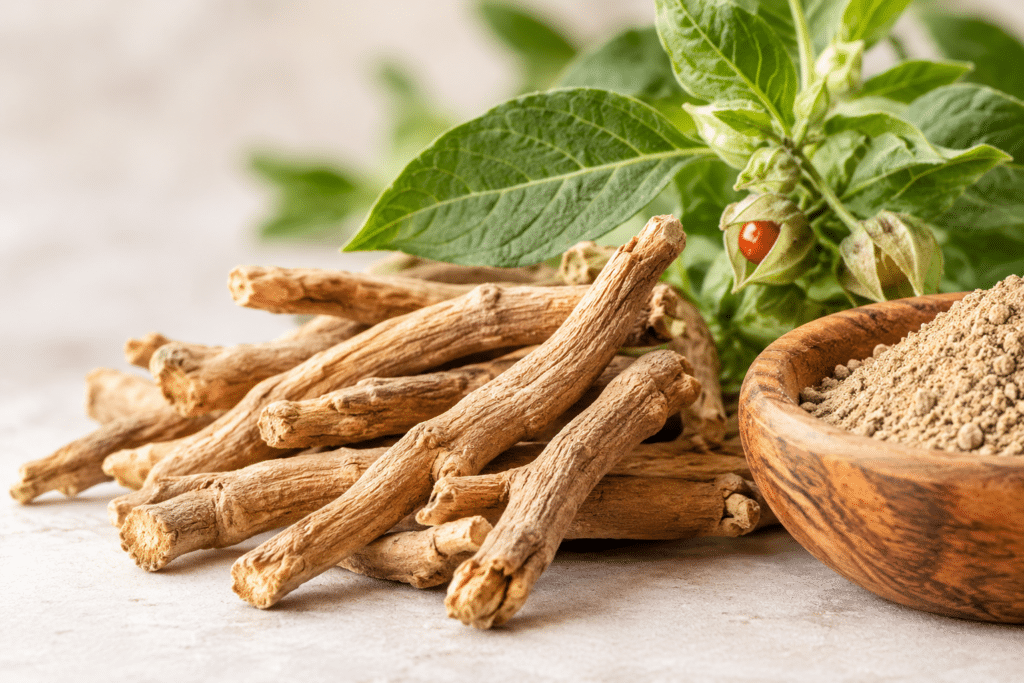
Ashwagandha and stress research shows the herb consistently lowers cortisol in clinical trials, yet meta-analyses disagree on whether it meaningfully reduces perceived stress, making it a plausible short-term supplement rather than a proven alternative to evidence-based therapy like CBT for managing chronic stress and anxiety.
What if your ashwagandha supplement is quietly lowering your cortisol while doing nothing for how stressed you actually feel? The research shows those two things do not always move together, and knowing the difference matters more than any bottle's label.
What ashwagandha is, and what it is proposed to do
What is ashwagandha and how does it help with stress?
Ashwagandha is the common name for Withania somnifera, a root used in Ayurvedic practice for centuries and sold in the United States as a dietary supplement rather than a regulated drug. That last distinction matters. Supplements are not approved by the FDA the way medications are, and manufacturers are not required to prove effectiveness before selling a product. Ashwagandha is proposed to help with stress by acting on the body’s stress response system, though the specific pathways are still being studied rather than settled fact. The rest of this article uses that framing throughout: what is proposed versus what has been tested.
Withanolides and what standardization on a label means
Withanolides are a group of naturally occurring compounds in the ashwagandha plant, and they are the compound group most supplement labels standardize to. When a label lists a standardization percentage, it means the manufacturer has measured and controlled the amount of withanolides in each dose, so the product contains a consistent concentration batch to batch. This does not tell you what dose was used in any particular study, or which named extract was tested, only that the label is making a claim about consistency. Withanolides are the reason ashwagandha extracts can vary so much from one bottle to another.
The proposed mechanisms, and why ‘proposed’ is the operative word
Ashwagandha is often described using the word adaptogen, a term from traditional medicine and pharmacology rather than a formal regulatory classification. According to a review tracing the evolution of the adaptogenic concept, the category describes substances proposed to help the body resist and recover from stress broadly, not a specific drug class with a fixed mechanism. Calling something an adaptogen does not by itself tell you what it does in the body or how well it works. The mechanisms proposed in the literature for ashwagandha include effects on the hypothalamic-pituitary-adrenal axis, or HPA axis, the system that governs the release of cortisol, the hormone most associated with the body’s stress response. Other proposed mechanisms involve GABA and serotonin signaling, two neurotransmitter systems linked to mood and anxiety, relevant to conditions like anxiety. None of these mechanisms are confirmed, and later sections work with the vocabulary this section has now defined: withanolide, standardized extract, cortisol, HPA axis, and the outcome measures researchers use, including the Perceived Stress Scale, the Hamilton Anxiety Rating Scale, standardized mean difference, heterogeneity, and GRADE.
What the research shows on stress and cortisol
What does research say about ashwagandha and stress relief?
Most of the ashwagandha stress clinical trials behind this question are small and short, run over a matter of weeks in adults who report everyday stress rather than a diagnosed condition, and several were funded or supported by the supplement manufacturer whose extract was being tested. That funding pattern does not automatically invalidate the results, but it means the results should be read with that context attached. A systematic review and meta-analysis of 15 randomized controlled trials covering 873 patients found that ashwagandha reduced anxiety scores, perceived stress, and cortisol compared to placebo at eight weeks. The same review found no significant improvement in quality of life, even where stress and anxiety markers moved in a favorable direction, which is a reminder that feeling less stressed on a scale and feeling better in daily life are not automatically the same outcome.
Cortisol findings versus self-reported stress findings
Ashwagandha cortisol research and self-report research do not always agree, and that mismatch is one of the more important things the evidence shows. The 873-patient meta-analysis reported significant drops in both cortisol and perceived stress scores at eight weeks. A separate systematic review and meta-analysis of 13 randomized controlled trials with 488 participants found a significant reduction in cortisol but no significant effect on perceived stress. Put side by side, one body of pooled trial data shows both markers moving together, and another shows a biological marker shifting while the psychological experience of stress does not budge. That disconnect matters because a person’s felt sense of being stressed and their measured cortisol level are two different things being measured with two different instruments, and a supplement can affect one without affecting the other.
Where the evidence is thin: duration, population, and funding
What the evidence actually says about ashwagandha and stress is bounded by how the trials were built, not just by what they found. Both meta-analyses pooled trials that varied by extract, dose, and length, which is part of why they landed on different effect sizes and different confidence in their own conclusions. The 13-trial review rated risk of bias as generally moderate across the included studies and found no evidence of publication bias, but it named clear gaps around long-term safety and dosing across different populations. Neither review speaks to use beyond a few months, to people with a diagnosed anxiety or depressive disorder who are already on other treatment, or to whether any benefit lasts after someone stops taking it. Those are open questions the published trials were not designed to answer, not conclusions the trials reached and then hid.
Two research teams have now pooled the randomized trials on ashwagandha and stress into a single ashwagandha meta-analysis, and they do not fully agree with each other. Reading them side by side shows both where the evidence is solid and where it gets shaky.
The comparison table, row by row
A systematic review and meta-analysis of 15 randomized controlled trials, covering 873 participants, found that ashwagandha significantly reduced anxiety on the Hamilton Anxiety Rating Scale (a drop of 3.52 points at 8 weeks compared to placebo), lowered perceived stress scores, and reduced cortisol levels, all with statistically significant results. Quality of life did not improve despite those changes. A second meta-analysis of 13 randomized controlled trials with 488 participants found a significant reduction in cortisol (-1.16 µg/dL, 95% CI -1.64 to -0.69) but no significant effect on perceived stress scores (SMD -0.355, 95% CI -1.188 to 0.47). Laid out plainly, the 15-trial review pooled 15 trials and 873 participants, measured anxiety, stress, and cortisol, found an effect size of HAM-A -3.52 at 8 weeks and PSS -4.88, and reported a significant reduction in stress. The 13-trial review pooled 13 trials and 488 participants, measured cortisol and perceived stress, found an effect size of cortisol -1.16 µg/dL, and reported no significant result on stress.
Both agree ashwagandha lowers cortisol. They disagree on whether that translates into people feeling less stressed.
Why the numbers disagree between papers
The two reviews did not pool the same trials or the same instruments. Different inclusion criteria mean one team accepted studies the other excluded, and different outcome scales, some using the Perceived Stress Scale, others using different anxiety instruments, get combined in ways that shift the pooled number. How each team handled ashwagandha effect size heterogeneity, meaning how much the individual trial results varied from each other, also changes the final estimate. A high heterogeneity statistic, often reported as I squared, tells you the trials behind a pooled number do not closely resemble each other. When I squared is high, a large pooled effect can hide a mix of trials with very different doses, populations, and results, some showing a strong effect and others showing none.
What the authors’ own certainty ratings mean for you
A GRADE certainty rating is the authors’ own judgment of how much confidence to place in a pooled result, graded high, moderate, low, or very low based on study quality, consistency, and precision. A low or very low rating does not mean a finding is false. It means the current trials are too few, too different, or too imprecise to treat the number as settled. For a reader deciding whether to try something, that distinction matters more than the headline percentage.
What a few points on a stress scale actually feels like
The Perceived Stress Scale runs from 0 to 40. That fixed range matters, because it lets you turn any reported number into a fraction of the whole instead of treating it as an abstract point total. A systematic review and meta-analysis of 15 randomized controlled trials found an average perceived stress change of about 4.88 points after 8 weeks of ashwagandha supplementation compared to placebo. Set against a 40-point range, that is roughly one-eighth of the total scale, which gives you something to reason about rather than just a number that sounds impressive on its own.
That 4.88 is a group average, not a guarantee. In the same trials, some participants likely moved more than that and some barely moved at all, since averages flatten individual variation by design. Whether a change of that size clears a minimally important difference on the stress scale depends on published thresholds for what counts as noticeable, and where a trial does not report against such a threshold, the honest answer is that the comparison cannot be made rather than guessed at.
Statistical significance, the label attached to that 4.88 figure, tells you the difference is unlikely to be due to chance. It does not tell you whether the change is large enough for you to notice on an ordinary Tuesday. Those are two separate questions, and conflating them is how a modest average gets reported as a dramatic effect. The same two questions are worth asking of any supplement study you come across later: what fraction of the scale actually moved, and does that number come with any sense of what counts as felt, everyday change?
Which extract was actually tested, and at what dose
A trial never tests “ashwagandha” as a plant. It tests a specific standardized extract, made a specific way, dosed at a specific amount, for a specific number of weeks. The name on your bottle matters because two products both labeled ashwagandha can contain different plant parts, different withanolide concentrations, and different doses than the ones a study actually used. Knowing which extract sits behind a claim is the only way to tell whether that claim applies to what you bought.
Named extracts and the trials that used them
A randomized, double-blind, placebo-controlled study tested a high-concentration, full-spectrum root extract in adults reporting stress, tracking anxiety and stress outcomes against placebo over the course of the trial. Separately, a randomized, double-blind, placebo-controlled study of a standardized ashwagandha root extract containing 2.5% withanolides followed 50 healthy adults over 60 days, and found improvements in perceived stress and generalized anxiety scores, along with reduced morning cortisol and increased urinary serotonin compared to placebo. These are two different extracts, from two different manufacturing processes, tested in two different trials. Neither result transfers automatically to a third product just because all three say “ashwagandha” on the front.
Root versus root-and-leaf, and why doses do not transfer
Extracts made from root only carry a different withanolide profile than extracts blended from root and leaf. Withanolides are the compound class most ashwagandha research uses as a marker of potency, and the standardization percentage on a label tells you how concentrated they are, not how much plant material went into the capsule. This is part of why KSM-66 vs Sensoril comparisons come up so often: one is root-only, the other blends root and leaf, and their withanolide standardizations differ. A dose that produced results with one extract cannot be assumed to produce the same results at the same milligram count with another.
Reading a label against the study it cites, and what benefits actually showed up
What are the benefits of ashwagandha for stress? In the trials above, the reported benefits were reductions in perceived stress and anxiety scores, along with changes in cortisol and serotonin markers, specific to the extract and dose each study used. A label that says “clinically studied” is telling you research exists somewhere, not that this bottle matches it. Before trusting that phrase, check four things on the supplement facts panel: the extract name, whether it is root or root-and-leaf, the standardization percentage, and the milligrams per serving. Third-party testing can confirm a product contains what the label claims, but it does not confirm the extract matches the one used in any given trial, and US supplement regulation does not require that match before a product reaches shelves.
Doses used in research, and how ashwagandha is taken
Ashwagandha dosage for stress varies quite a bit from one trial to the next, with published studies using amounts that range from a few hundred milligrams a day up to a couple of grams. Some trials split the total into two doses, one in the morning and one in the evening, while others use a single daily dose taken at night. There is no single dose that the research converges on, which makes it hard to point to one number as standard.
How to take ashwagandha differs by product: capsules, loose powders mixed into water or milk, liquid tinctures, and gummies are all sold, and each delivers a different concentration of the plant’s compounds. Comparing a dose in one format to a dose in another is unreliable, because a gram of raw powder and a capsule of concentrated extract are not equivalent. Trials also differ on whether the supplement was taken with food or on an empty stomach, and that detail is not always reported clearly.
Duration and what happens afterward
Most published trials run for a matter of weeks rather than months or years, so what continuous use looks like over a longer stretch remains largely unstudied. This leaves an open question about whether effects hold steady, fade, or shift with extended use. Cycling ashwagandha, meaning taking it for a period and then stopping for a break, is a common practice, but it is not something the trial evidence directly supports or rejects. The same is true for stopping altogether: the literature does not describe a consistent withdrawal pattern one way or the other.
Because dosing, format, and duration vary this much across the research, applying any of it to a specific person’s health situation is not something a general overview can responsibly do. What fits one person’s body, other medications, or health history is individual, and that kind of judgment call sits outside what an article can offer.
Safety, contraindications, and named drug interactions
Ashwagandha side effects and interactions matter more than most supplement labels suggest. The herb is not automatically safe just because it is old or widely sold, and a short list of conditions and medications changes the calculation for specific people. This section covers what shows up in trial reports and what the pharmacology literature flags as a theoretical concern.
Reported side effects in trials
The most commonly reported side effects in clinical trials are gastrointestinal upset, drowsiness, and headache. Participants describe these as mild and short-lived in most trial writeups, but they are the reason some people stop taking it. Anyone managing anxiety alongside physical symptoms like stomach upset should treat a new supplement the same way they would treat a new medication: something to notice, not something to push through.
Thyroid, liver, and pregnancy
Ashwagandha thyroid liver pregnancy concerns are the three most specific contraindications in the literature. On thyroid function, a placebo-controlled trial in people with bipolar disorder found that ashwagandha-treated patients showed increases in T4 from baseline, while most placebo patients showed decreases, which raises a question for anyone with hyperthyroidism or taking thyroid medication. On the liver, a review of hepatotoxicity linked to herbs used in Ayush medicine documents case reports of liver injury tied to Withania somnifera, most self-limiting but some severe enough to raise concern. On pregnancy and breastfeeding, ashwagandha has traditionally been avoided in these periods and has not been studied for safety in either, so the honest answer is that adequate safety data does not exist.
Medication classes with documented or theorized interactions
Several medication classes carry either documented or theorized risk alongside ashwagandha. Sedatives, benzodiazepines, and alcohol raise the concern of additive sedation. Immunosuppressants and autoimmune conditions raise a different question, since ashwagandha is theorized to stimulate immune activity. Diabetes medications and blood pressure medications carry a theorized additive lowering effect on blood sugar and blood pressure. Supplements are also commonly flagged on pre-operative intake forms, since surgical teams want a full picture of anything that affects bleeding, sedation, or blood sugar before a procedure. In the US, supplements are not reviewed for safety or efficacy before they reach the shelf the way prescription drugs are.
When cortisol drops but you do not feel less stressed
A supplement can change a lab value without changing how a day feels. That gap sits at the center of the cortisol vs perceived stress question, and it is worth sitting with instead of explaining away.
Why a biomarker and a feeling can disagree
Cortisol is one measurable output of a stress response, not a score for how stressed a life is. A systematic review and meta-analysis of 13 randomized controlled trials found that ashwagandha produced a statistically significant drop in cortisol, but no significant change in how participants rated their own stress. Both results are real. The body’s chemistry moved. The lived experience of pressure, deadlines, or a hard conversation with a partner did not move with it, because that experience was never only a chemical readout in the first place.
What actually tends to shift felt stress
Chronic stress driven by workload, caregiving, financial pressure, or unprocessed experience does not have a biochemical shortcut, because the input causing it has not changed. What tends to move felt stress is closer to the source: more consistent sleep, a lighter demand load, boundaries that actually hold, regular contact with other people, and structured work on the thoughts and patterns that keep the stress response switched on. A supplement can sit alongside those changes. It cannot substitute for them, and asking it to is where the disappointment usually starts.
When stress has moved past what a supplement can address
Some signs suggest the stress has stopped being situational and is worth treating as a clinical concern rather than something to manage alone. These include sleep disruption that persists most nights, panic symptoms, pulling away from people you’d normally rely on, losing function at work or home, or feeling flat and numb rather than keyed up. In the moment a spike hits, grounding through pressure, weight, texture, or naming five things in the room can bring the nervous system back down a notch. If stress has stopped responding to sleep, time off, and anything you can buy in a bottle, you can create a free ReachLink account and browse licensed therapists at your own pace, with no commitment. Chronic stress support sometimes means a supplement and sometimes means a different kind of help entirely, and the meta-analysis on cortisol and perceived stress is one piece of evidence you can check for yourself when deciding which.
How ashwagandha compares with other approaches to stress, and the honest bottom line
Ashwagandha against other supplements marketed for stress
Ashwagandha is one of the more studied supplements in its category, but that says more about how thin the category is than how strong the evidence for ashwagandha happens to be. Magnesium has a smaller and less consistent body of human trials behind it, mostly looking at sleep and muscle symptoms rather than stress directly. L-theanine has a handful of small studies, often combined with caffeine, which makes it hard to isolate what the amino acid itself is doing. None of these three supplements has a large, independently funded trial base, so ranking them against each other is really a comparison of which one has slightly more evidence of a similar kind.
Ashwagandha against approaches with larger evidence bases
When you compare ashwagandha to approaches like structured talk therapy, exercise, and sleep changes, the volume of evidence is not close. Cognitive behavioral therapy has decades of trials across many conditions, including anxiety and low mood, with a research base far larger and more varied than anything available for an herbal supplement. Exercise and sleep research spans a similarly wide range of study designs and populations. This is not a statement about what any one person should choose. It is a statement about how much has actually been tested, and for how long, compared to a supplement literature still made up mostly of small, short trials.
Is ashwagandha the best supplement for stress?
That question cannot really be answered as asked, because “best” implies a head-to-head comparison that has not been done. No trial has tested ashwagandha directly against magnesium or L-theanine in the same group of people using the same outcome measures. A more answerable question is what each supplement has been tested for, in what kind of study, and whether that evidence holds up under scrutiny. On that narrower question, ashwagandha has more trials than most of its competitors, but the trials share the same weaknesses of size and funding.
The honest bottom line
The evidence supports ashwagandha as a plausible, mildly studied option for stress, not as a proven treatment on par with therapy or established lifestyle changes. What it does not support is any claim of reliability, consistent effect size, or long-term safety across years of use. The field’s own confidence is modest: researchers describe the findings as promising and in need of replication, not settled. Someone who tries it anyway is running a small personal experiment with limited data behind it, which is a reasonable thing to do as long as it is understood that way. What would change this picture is longer trials, funding independent of supplement manufacturers, standardized extracts and outcome measures across studies, and direct comparisons against other supplements or against approaches like cognitive behavioral therapy, including in people managing depression alongside stress. Until then, the honest summary is that ashwagandha vs other stress supplements is a contest between small literatures, not a settled ranking, and the best supplement for stress is still an open question rather than a name.
Wanting something that actually works is not too much to ask
Wading through supplement claims while your nervous system is still frayed is exhausting, and wanting a straight answer instead of another headline is completely reasonable. The evidence on ashwagandha can inform what you try, but it cannot untangle the deeper patterns behind chronic stress, the racing thoughts at night, or the sense that your body never fully relaxes. That kind of steady change usually comes from support built around your actual life, not a bottle on a shelf.
If you have been carrying this alone for a while, it may be worth talking to someone who can look at the whole picture with you. You can begin with a free assessment at ReachLink, at your own pace and with no commitment, and let a care coordinator match you with a therapist afterward: begin with a free assessment at ReachLink.
FAQ
-
Does ashwagandha actually work for stress, or is the research mostly hype?
The research on ashwagandha and stress shows modest, mixed results rather than a clear verdict either way. Two recent meta-analyses both found that ashwagandha significantly lowers cortisol, but they disagreed on whether it makes people feel less stressed - one found reduced perceived stress scores, while the other found no significant change in how participants rated their own stress. Most trials behind these findings are small, short, and often funded by supplement manufacturers, which is worth knowing before treating any headline claim as settled. Trying ashwagandha is a reasonable personal experiment as long as you go in understanding that the evidence is promising but not conclusive.
-
Can therapy actually help with chronic stress, or do I need to fix the root cause on my own first?
Therapy is actually designed to help you identify and work through the root causes of chronic stress, so you do not need to have everything sorted out before starting. Approaches like cognitive behavioral therapy (CBT) give you structured tools to examine the thoughts, habits, and patterns that keep your stress response switched on, rather than just managing symptoms after the fact. The evidence base for therapy in stress and anxiety is far larger and more varied than anything available for supplements, with decades of trials across many conditions and populations. Working with a licensed therapist means getting support that is built around your specific situation, not a general formula applied to everyone.
-
If ashwagandha lowers my cortisol but I still feel stressed, does that mean it's not working?
That disconnect is actually documented in the research and worth taking seriously. Cortisol is one measurable output of the body's stress response, not a direct score for how pressured, overwhelmed, or tense you feel from day to day. At least one large meta-analysis found that ashwagandha produced a statistically significant drop in cortisol without producing any significant change in how participants rated their own stress. A supplement that shifts a lab value but not your lived experience has done something, but not necessarily the thing you were hoping for. What tends to move felt stress is closer to its source - more consistent sleep, a lighter demand load, and structured work on the patterns that keep the stress response activated.
-
What are the signs that my stress has gone beyond what a supplement or lifestyle change can handle on its own?
Some signs suggest stress has shifted from situational to something worth addressing with professional support. These include sleep disruption that persists most nights, panic symptoms, withdrawing from people you would normally rely on, losing function at work or at home, or feeling numb and flat rather than just keyed up. If stress has stopped responding to rest, time off, or anything available in a store, that is often a signal that the patterns behind it need a different kind of attention. A licensed therapist can help you work through those patterns in a structured, evidence-based way, rather than continuing to manage symptoms one at a time.
-
I think I'm ready to talk to a therapist about my stress - how does that actually work at ReachLink?
Starting is simpler than most people expect, and you do not need to have a clear diagnosis or a tidy explanation of your stress before reaching out. ReachLink begins with a free assessment you can complete at your own pace and with no commitment required. After your assessment, a human care coordinator, not an algorithm, reviews your situation and matches you with a licensed therapist based on your needs and preferences. Your first sessions will typically focus on understanding what is driving your stress and building a plan together, so the work starts from where you actually are rather than where you think you should be.