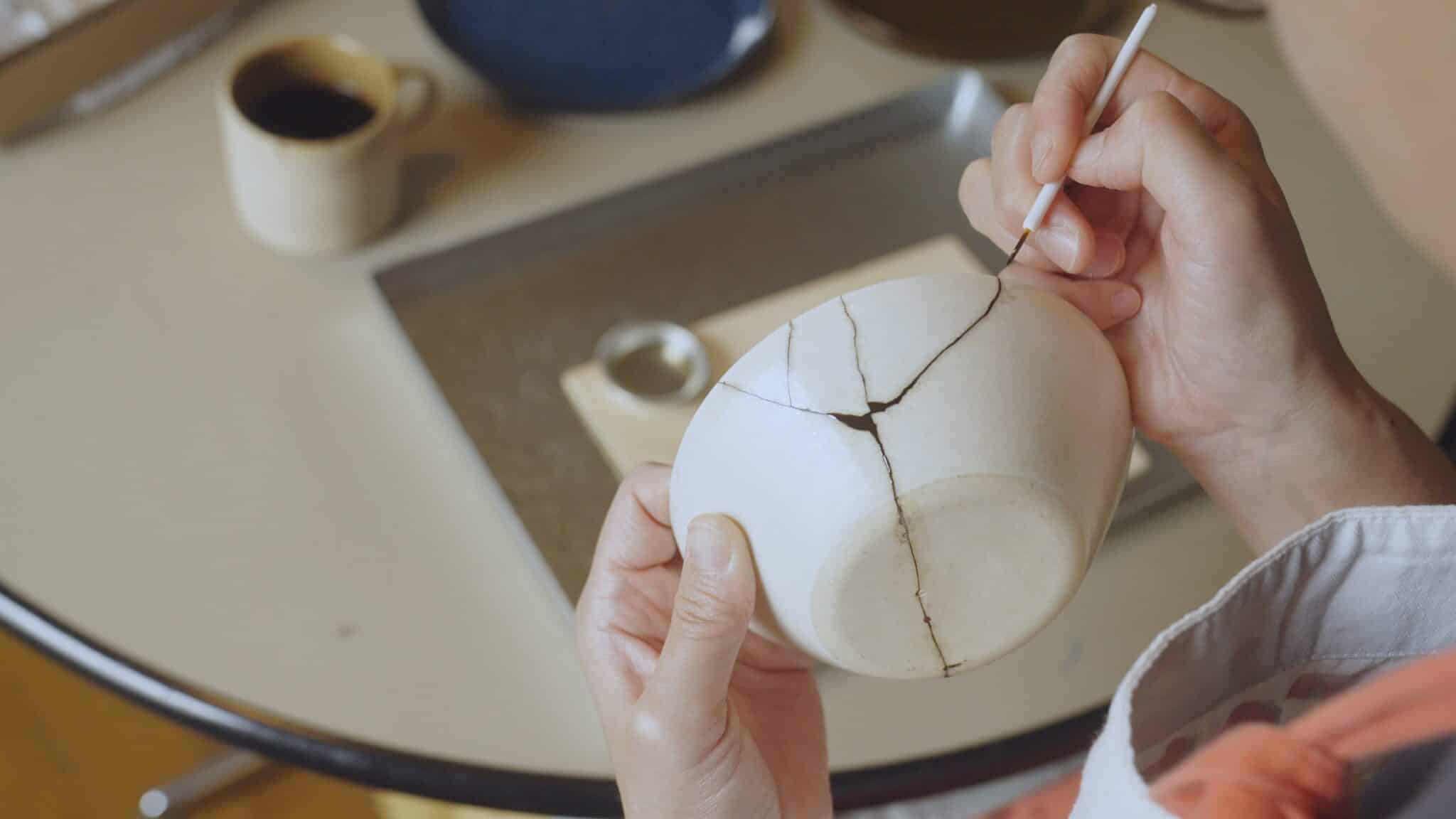
Kintsugi, the Japanese art of repairing broken pottery with gold, teaches that healing means integrating damage into your story rather than concealing it, a principle that mirrors post-traumatic growth and the work of narrative therapy, where licensed therapists help individuals rebuild meaning from loss without forcing false positivity or premature closure.
What if the parts of you that broke are actually what make you worth looking at closely? Kintsugi teaches that a repaired bowl can outshine an untouched one, gold seams and all. Here's what that ancient practice reveals about mending yourself without hiding the cracks.
A broken bowl mended with gold has become one of the most repeated images in the language people use for healing. It shows up on book covers, in therapy offices, and in captions written the week after something fell apart. The image is genuinely beautiful, and it also gets used to skip over the part that takes the longest. This article looks at where kintsugi actually came from, what the repair involves, what the metaphor gets right about recovery, and where it stops being useful.
Where kintsugi came from, and the bowl that started the story
One story gets told more than any other. A shogun’s favorite tea bowl broke, and he sent it to China for repair. It came back held together with metal staples, functional but ugly, and the craftsmen he showed it to started looking for a way to mend ceramics that would be worth looking at rather than something to hide. That search is where the practice most people now call kintsugi is said to begin.
The timing lines up with the rise of the Japanese tea ceremony during the Muromachi period, when tea gatherings turned into a setting where the right bowl mattered as much as the tea itself. A vessel’s past use, its age, even its damage, became part of what made it worth owning. Bowls that had been broken and mended with visible gold seams circulated among collectors and hosts, and a repaired piece could hold its place at a gathering rather than get quietly retired.
A visible seam read as a record, not a flaw. That distinction matters here because kintsugi did not start as a philosophy someone invented to make loss feel better. It started as a practical response to a broken object that someone still wanted to use.
The philosophy underneath the gold: beauty in imperfection and impermanence
The gold is the part people notice, but the reasoning behind it is older than the technique. Several Japanese ideas about wear, waste and change converge in a mended bowl, and they are not interchangeable. Separating them makes it clearer what kintsugi is actually claiming.
What is the philosophy behind kintsugi?
Kintsugi philosophy treats a break as part of an object’s history rather than a defect to hide. The repair does not pretend the damage never happened. It puts the crack on display, filled with lacquer and dusted in gold, so the object’s whole life stays visible at once: made, used, broken, mended. That stance did not appear in isolation. It draws on a handful of older Japanese aesthetic and spiritual ideas that shape how breakage, wear and repair get read.
Wabi-sabi, mottainai and mushin, and how they differ
These three ideas overlap with kintsugi but are not the same thing, and each does different work. Wabi-sabi is an aesthetic sensibility: an appreciation for the weathered, the asymmetrical and the incomplete, the opposite of polished symmetry. A 2019 essay in the Journal of Medical Humanities describes wabi-sabi and kintsugi as frameworks that locate beauty in irregularity and visible signs of repair, in contrast to modern ideals built around flawlessness. Mottainai is an ethic, not an aesthetic: a refusal to discard something that still has use, which turns mending into a form of respect rather than mere frugality. Mushin is a state of mind, often translated as “no mind,” the quality of accepting change and loss without gripping onto how things used to be, which shows up in how a mended bowl gets handled afterward, without flinching or apology. Impermanence sits underneath all three as a starting assumption: everything is either already broken or on its way there.
Why is kintsugi considered beautiful?
Kintsugi is considered beautiful because it makes the repair the visible center of the object instead of something to conceal. That reversal is what the same Journal of Medical Humanities essay points to when it contrasts wabi-sabi’s embrace of flaws with aesthetic standards that treat symmetry as the only acceptable outcome.
How the repair is actually made: lacquer, gold and the three joinery types
The kintsugi technique starts with urushi, a lacquer made from the sap of the urushi tree. Urushi is not glue in the ordinary sense. It hardens through a chemical reaction that needs humidity rather than dryness, so mended pieces sit in a controlled damp chamber while each layer sets. That curing happens in stages, and every stage waits on the one before it.
Once the structural layers have set, the seam gets a dusting of metallic powder, usually gold, sometimes silver or brass. This is the step that makes the repair the visible feature of the object: the powder sits directly on the last tacky layer of lacquer so the crack line catches light instead of hiding under a color match. The seam is meant to be seen.
Three situations call for different handling. In crack repair, the original pieces still exist and rejoin along their own break lines. In the piece method, a fragment is missing entirely, so the gap is rebuilt from solid lacquer and gilded like the rest. In yobitsugi, or joint call, a fragment from a completely different vessel is fitted into the gap, producing an object that was never a single whole to begin with.
None of this is fast. Coats go on thin, one at a time, with real waiting between them.
Why repaired can be more beautiful than intact
An intact bowl tells you nothing about itself. It has no history you can see, no evidence of what it has been through or who has cared for it. A bowl mended with gold carries a record: it broke, and someone thought it was worth the slow work of putting back together. That record is the whole argument. The reframe here is not that breaking is good. It is that hiding the break costs something, and the gold refuses to pay it.
What does kintsugi teach us about healing?
Kintsugi and healing meet at exactly this point: repair does not mean returning to how something looked before. It means the damage becomes part of what the object is now, visible rather than sanded away. This is different from resilience defined as bouncing back. It is closer to a life that keeps the mark and keeps functioning, repaired not hidden.
How does kintsugi relate to personal growth?
People describe a similar shift in themselves after something difficult: they stop organizing daily life around concealing a period of it. That shift has a name in the research literature, post-traumatic growth, a construct Richard Tedeschi and Lawrence Calhoun developed to describe changes some people report after hard events, including altered priorities and closer relationships. It is described as something reported, not something guaranteed or owed to anyone who has been through trauma. MeKenzie Russell Lane, LPC/MHSP frames a related shift around grief: “You don’t move on from grief, so it’s bringing it with you into this new version of yourself.” That is integration, not erasure, and it is close to what narrative therapy works with when someone rebuilds the story of their own history.
The seam is the point, not the flaw
The metaphor holds tightly in a few places. The repair is visible. The object gets used again, not retired to a shelf. It is stronger at the seam only because someone did deliberate, slow work there, not because breaking made it stronger on its own. It also stops being true at an obvious point: a bowl does not consent to being mended, and it does not feel any of it. A person does both, which is where the metaphor ends and the actual work begins.
What kintsugi is not: the limits of a beautiful idea
The metaphor gets reached for too early sometimes. A bowl gets photographed with its gold seams before the person holding it has felt any of the loss underneath, as if looking at a finished object could substitute for the months it actually takes to cure the lacquer. Certain coping patterns can create the illusion of having processed grief when the pain remains unexamined underneath. The image of transformation becomes a substitute for the work rather than evidence of it.
On the gap between feeling finished with something and actually being finished with it, Naomi Burks, LMFT says: “There are things that happen to us that we come across in our lives and we might compartmentalize or we move past it and we feel like we’ve worked on it or we’re good or whatever. I forgave or I’m not forgiven and boom, you’re triggered. And then you’re like, why am I feeling this way? So we need to work on those core issues or concerns.” A gold seam painted on before that work happens is not repair. It is a good photograph of an unrepaired object.
Telling someone that everything broken becomes beautiful can land as an order rather than a comfort, especially while they are still inside the grief and nothing about it feels golden yet. This is close to toxic positivity: a demand to reframe pain before the pain has been allowed to exist. Some losses never resolve into meaning at all, and a metaphor that insists they must becomes another thing to fail at, on top of the loss itself. For someone already carrying low self-esteem, the implied standard, that they should be finding the beauty in this by now, can do more damage than the original break. If what you are carrying ever feels heavier than you can hold on your own, the 988 Suicide and Crisis Lifeline is available 24 hours a day by call or text.
How kintsugi differs from other repair
Other repair traditions aim the opposite direction. Invisible mending is built to erase the break entirely, and restoration returns an object to something like its original state, as though the damage never happened. Kintsugi does neither. It never claims the break was good. It only insists that hiding it would cost the object something a second time.
Taken carefully, the image is useful for reflection rather than for conclusions. What follows is less about the bowl and more about how to look back at a hard period without getting pulled back into it.
Reflection prompts that stay on the seam
A useful prompt asks what changed in how you live, not what happened to you. Writing about the break itself tends to loop: the same scene, the same details, no new ground. Writing about the seam instead means asking questions like what you do differently now, what you no longer tolerate, or what you notice sooner than you used to. That framing keeps the reflection tolerable because it points forward through the change rather than back through the injury.
Staying grounded while you look back
Looking back at something hard can pull you out of the present moment, so grounding gives you a way to stay connected to it. Pressure through your feet on the floor, the weight of a mug in your hands, or naming five things you can see in the room all work the same way: they anchor thinking to something physical and current. Use one of these if the reflection starts to feel like reliving rather than reviewing. The goal is not to stop thinking about it, just to keep one foot in the present while you do.
It also helps to name the repair work you have already done and who did it with you. Kintsugi is a repair performed on an object by someone else, not a repair the bowl makes on itself. Naming the people, therapists, friends, or family who helped you put things back together keeps the metaphor honest about the fact that healing rarely happens alone.
When reflection needs more than a notebook
Narrative therapy is the modality most aligned with this kind of work. It treats the story you tell about your life as something you can examine and revise, looking at which events you have let carry the meaning and which ones you might let carry it instead. A repeated record kept over weeks, through reflective journaling or a simple mood log, often shows shifts that memory alone flattens out. But reflection has a ceiling. If the looking back keeps opening more than it settles, you can create a free ReachLink account and browse licensed therapists at your own pace, with no commitment.
The cracks you carry are not proof that you failed
Whatever broke in you, whether it happened slowly or all at once, does not disqualify you from wholeness. The mending itself becomes part of who you are, visible if anyone looks closely, and there is nothing shameful in that. You do not have to hide the seams or pretend they were never there. Healing was never about returning to some untouched version of yourself. It is about becoming someone who can hold the break and the repair together, and finding that this person is not lesser for it.
If you are ready to have support while you do that work, you can start with a free assessment at ReachLink, which takes only a few minutes to begin. A care coordinator can use what you share to help find a match suited to what you are carrying. You get to decide when and how you take that next step, and there is no timeline you need to meet but your own.
FAQ
-
What does kintsugi actually mean and why do people connect it to emotional healing?
Kintsugi is a Japanese art form that repairs broken ceramics with lacquer mixed with gold, silver, or other metals, making the cracks visible rather than hiding them. The philosophy behind it treats a break as part of an object's history, not a flaw to conceal, so the repaired piece carries its full story, damage and all. People connect this to emotional healing because it offers a different way of thinking about personal difficulty - not as something to get over and move past, but as something that becomes woven into who you are. The core insight is that hiding what broke you costs something, and that the work of repair, done slowly and deliberately, can become the most meaningful part of your story.
-
Can therapy actually help me stop feeling like I need to hide the hard things I've been through?
Yes, therapy can be genuinely helpful for people who feel pressure to conceal difficult periods of their lives or who carry a sense of shame around past experiences. Approaches like narrative therapy specifically focus on the story you tell about your own life, helping you examine which events you've let define you and whether you want to rewrite that framing. A licensed therapist can also help you distinguish between having processed something and having only compartmentalized it, which are not the same thing even when they feel similar. Over time, many people find that therapy helps them carry their history without being controlled by it.
-
What if the idea that my pain will make me stronger actually makes me feel worse?
The kintsugi metaphor, like any reframe around suffering, can land as pressure rather than comfort if it arrives before someone has had space to feel the loss underneath. Telling yourself or someone else that everything broken becomes beautiful can function like toxic positivity - a demand to find meaning in pain before the pain has even been allowed to exist. Some losses never resolve into a tidy lesson, and a framework that insists they must can become one more thing to fail at on top of the original hurt. If inspiration around healing consistently makes you feel behind or inadequate, that reaction is worth paying attention to, and a therapist can help you work at a pace that fits where you actually are, not where a metaphor suggests you should be.
-
How do I find the right therapist to help me work through something painful from my past?
Finding a therapist who is a good fit for what you're carrying can feel overwhelming, especially when you're already dealing with something difficult. ReachLink connects people with licensed therapists through human care coordinators rather than an algorithm - you complete a free assessment that helps a real person understand what you're working through, and they use that information to match you with a therapist suited to your needs. There's no commitment required to start, and you can move at your own pace. If you're ready to take that first step, you can create a free account at ReachLink and begin the process whenever it feels right for you.
-
What is narrative therapy and how is it different from other types of talk therapy?
Narrative therapy is a form of talk therapy that treats the story you tell about your own life as something you can examine, question, and rewrite over time. Rather than focusing only on symptoms or behaviors, it looks at which life events you've let carry the most meaning and invites you to consider whether other parts of your story deserve more weight. It's particularly useful for people who feel defined by a painful period or who have organized their sense of self around something they'd rather not have at the center of their identity. A licensed therapist trained in narrative approaches can help you build a fuller account of who you are, one that includes difficulty without being reduced to it.