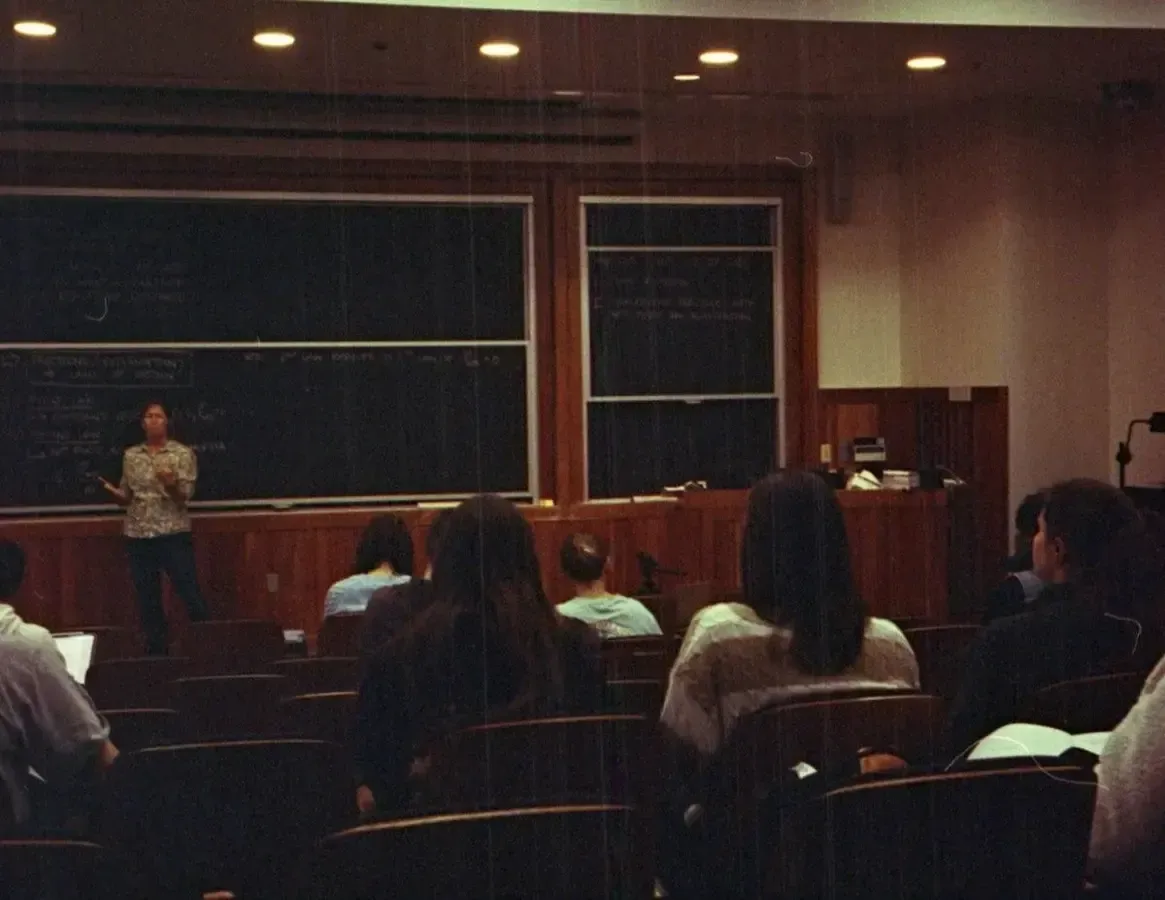
Nontraditional students often experience imposter syndrome when age gaps, career changes, and caregiving demands make normal self-doubt feel like proof they don't belong, but self-compassion practices and cognitive behavioral therapy with a licensed therapist can ease these feelings and build lasting academic confidence.
What if feeling like a fraud in class has nothing to do with your ability? Nontraditional students often carry quiet self-doubt that grows louder with every assignment, no matter how well they perform. Here's why that happens, and how real support can help the feeling finally loosen its grip.
What impostor phenomenon is, and how often it shows up in higher education
Impostor phenomenon describes a persistent internal belief that your achievements come from luck, timing, or other people's mistakes, paired with a quiet fear that someone is going to notice you do not belong. It is not a diagnosis. You will not find it in the DSM, which is part of why imposter syndrome article writing and clinicians more often use the word phenomenon or experience rather than syndrome. Syndrome implies a fixed clinical category. What researchers are describing is closer to a recurring pattern of thought, one documented across a wide range of people rather than a flaw in any one of them.
What separates it from ordinary first-week nerves is that the nerves are supposed to fade as evidence builds that you can do the work. With impostor phenomenon, the evidence keeps arriving and the belief does not update. A paper gets assigned, anxiety spikes, you over-prepare or you procrastinate until panic forces the work out of you, the work turns out fine, and you credit the all-nighter or the lucky question on the exam instead of your own ability. The cycle resets with the next assignment.
Imposter syndrome research reviewing 62 studies across more than 14,000 participants found reported rates ranging from 9 to 82 percent depending on which screening tool was used, with notably higher rates among ethnic minority groups. That range is wide partly because what causes imposter syndrome and how it gets measured varies study to study, but the volume of research itself tells you this is a studied pattern in student and professional populations, not a personal shortcoming. Some of that research has looked specifically at students who differ from the typical makeup of their classroom. A nontraditional student might be returning to school after a gap, working full time, parenting or caring for family while enrolled, the first in their family to attend college, changing careers, studying part time, or simply older than the classmates around them.
Why returning to school as an older student sets off imposter feelings
What causes imposter syndrome in a returning student usually is not one thing. It is several ordinary pressures stacking on top of each other until they start to feel like proof of something. Imposter syndrome research sorts these pressures into categories: demographic, academic, career, and family. Seeing them as separate, mapped factors, rather than a single personal flaw, changes how the feeling sits with you.
Why do nontraditional students feel like imposters in class?
The demographic gap is usually the engine. Being visibly the only person in the room who does not match the rest of the cohort turns normal first-week uncertainty into a bigger question: do you actually belong here at all. That question does not show up the same way for a 35-year-old sitting among 19-year-olds as it does for a traditional student, because the age difference itself becomes a marker that something is off. A study of 959 graduate students and professionals in STEM and medicine found that older age groups and people no longer in active training reported lower impostor phenomenon scores overall, which suggests the discomfort nontraditional students feel is tied to the newness of the situation, not to some fixed trait about being older.
Academic factors add to this. A long gap since your last exam means you are relearning how to study at the same time you are learning the material itself. Citation software, new learning platforms, and course portals that your classmates have used for years can turn a simple assignment into a research project of its own. There is also a specific, sharper fear: raising your hand to ask something that the 20-year-old next to you seems to already know, as if everyone else got a syllabus you missed.
Career concerns and professional identity for career changers
If you are changing fields entirely, the self-doubt often has a professional shape. You can feel like an amateur in a field you are training to practice in, even while you are doing the coursework competently. There is also a quieter worry underneath that: whether a credential earned later in life will be read by employers as equal to one earned at 22. That worry is about legitimacy, not ability, and it tends to follow career changers specifically rather than nontraditional students in general.
Family, caregiving and the cost of claiming study time
Family and caregiving pressures are a real factor in this pattern, not a scheduling inconvenience. Competing obligations, a partner or children whose routines get rearranged around your class schedule, and the guilt of blocking off hours for yourself all add weight to the sense that you are an imposter for taking up space meant for school. If you are also the first person in your family to attend college, there is an added layer: no one at home can tell you what is normal in week three, because no one has done this before you.
Part of what makes all of this harder to shake is that the comparison itself is unfair. You are measuring your learning curve on an unfamiliar system against classmates who have done nothing but school, continuously, for fourteen years straight. That is not a fair baseline, and the gap it produces is not something you failed to close. It is a different starting line.
What carrying imposter feelings costs your well-being
Imposter feelings rarely stay contained to how you think about yourself in class. A pilot study of medical students found that impostor syndrome was significantly associated with emotional exhaustion, cynicism, and depersonalization, the core components of burnout. A separate study of first-year medical students found that impostor phenomenon was linked to shame, embarrassment, and inadequacy, which in turn raised the likelihood of depression and anxiety symptoms. None of this means something is wrong with you for feeling it. It means the feeling has a cost worth naming, separate from whatever caused it.
The behavioral costs are often easier to spot than the emotional ones, if you know where to look. Not raising your hand. Not going to office hours. Not applying for the research assistantship because you assume someone younger is more qualified. Not mentioning that you work forty hours a week, as if that fact would confirm you do not belong rather than explain why you are tired.
Over-preparation hides inside the opposite behavior: doing more, not less. Rereading a chapter five times, drafting an email three times before sending it, rehearsing a comment you never make. It buys a short-lived relief that resets before the next assignment, so the hours spent never actually close the gap you're trying to close. Pulling back from classmates can feel protective, but isolation removes the only evidence that would challenge the belief that you don't belong, which is part of why anxiety and low mood tend to deepen rather than ease with distance.
Some imposter feelings are a reasonable response to a genuinely unfamiliar setting, and they often fade as the setting becomes familiar. A fair line for seeking outside support: the feelings persist into your second or third term, they interfere with sleep or attendance, or you've started considering leaving a program you're actually passing.
A step-by-step self-compassion practice drawn from clinical research
Self-compassion is not a mood or a personality trait. Researchers describe it as three things happening together: self-kindness instead of self-judgment, a recognition that struggling is part of common humanity rather than a personal defect, and mindful awareness of the feeling instead of either suppressing it or drowning in it. For a nontraditional student sitting in a lecture hall of mostly 22-year-olds, this means treating the moment you feel slow or behind the way you would treat a capable friend who said the same thing to you out loud. That shift sounds small. The research on what it actually changes is not.
What the research protocol actually asked participants to do
A randomized study of 227 college students with impostor phenomenon tested a brief self-compassion intervention over four weeks and measured change using latent growth curve modeling. The intervention produced significant reductions in impostor phenomenon and in maladaptive perfectionism, the tendency to treat any shortfall as proof of fraudulence. The same trial also found that students who started out most afraid of being kind to themselves, and those with the lowest baseline self-evaluation, showed the largest drops in distress. The protocol was not a long course. It was short, structured, and repeated daily, which is the detail worth carrying into your own week.
The five steps, adapted for a classroom week
The exercise below mirrors the shape of that trial's daily practice, scaled to one lecture or seminar at a time.
- Catch the sentence. Write down the exact wording of the thought, not the vague feeling behind it. Not "I felt dumb today" but an example such as: everyone here is quicker than me. Charity Anderson, LPC frames this as the core move in cognitive behavioral therapy: thoughts that go unexamined keep running the show, and you cannot question a feeling you never pinned down in words. The exact wording matters because vague feelings resist examination, while a sentence on paper can be tested against reality.
- Name the feeling without arguing with it. Say, in the third person, "this is shame" or "this is fear of being exposed." Naming it this way creates distance without requiring you to prove it wrong yet.
- State the common humanity fact. Other students in that same room are carrying a version of that sentence right now. This is not reassurance. It is an accurate statement about what a classroom full of people usually contains.
- Write the friend rewrite. Imagine a classmate told you they felt like everyone around them was quicker than they were. Write down what you would actually say back to them. Then read your own words back, addressed to yourself.
- Log one piece of counter-evidence. One line, one fact: the grade you got back, the comment a professor made, the problem you solved this week. Write it somewhere you will reread, so the evidence has somewhere to accumulate.
Keep each round short, a few minutes at most, and run it daily rather than saving it for the days the thought gets loud. The trial that showed measurable change used a brief, repeated structure, not an occasional deep session.
What are some strategies for nontraditional students to manage feelings of inadequacy?
The strategies that hold up are small and immediate, usable in the middle of class rather than only afterward. When the thought spikes mid-lecture, press both feet into the floor and notice the contact. Feel the weight of your bag on your shoulder or the warmth of a cup in your hand. Name three objects on the desk in front of you, out loud in your head, one at a time. This kind of grounding borrows from the mindful awareness piece of self-compassion and overlaps with practices used in mindfulness-based stress reduction, where attention is anchored in the body rather than the spiral of thought. If people ask what is the opposite of imposter syndrome, this daily practice is closer to an answer than any single feeling: a baseline where the critical sentence still shows up sometimes, but no longer runs unexamined.
If you want something closer to imposter syndrome training with structure and outside support, cognitive behavioral therapy works with the same catch-the-thought mechanism in a guided setting. If the practice helps but the underlying belief does not move, you can create a free ReachLink account and browse licensed therapists at your own pace, with no commitment.
Your life experience is an academic asset, not a handicap
The years you spent working before returning to school are not a gap to explain away. They are context. When a younger classmate reads a case study about a difficult manager or a failed project, it is theoretical. When you read it, you can test it against something you actually lived through, which is its own form of prior knowledge, just built in a different classroom.
The same goes for the logistics of your life. Juggling deadlines, a budget, a conflict with a coworker, and a family obligation in the same week is self-regulation, and undergraduate study rewards exactly that skill, even though you learned it somewhere else entirely.
Clarity matters too. Adults who return to school usually know why they are there. That reason tends to survive a disappointing grade in a way that a vague, default enrollment right out of high school often does not.
There is one skill in particular that transfers almost directly: asking the uncomfortable question out loud. If you have done it in a meeting, you can do it in a seminar, and it is the thing classmates most often say they wish they could do themselves.
None of this means you are better than the classmates sitting next to you. It means you arrived with a different inventory, and the one you brought is not the deficient one.
So what is the opposite of imposter syndrome? It is not swinging to overconfidence untested by real experience. That is its own problem. The steadier goal is accurate self-appraisal, seeing your actual skills and actual gaps clearly. Can imposter syndrome be a good thing? Only in the narrow sense that it can push you toward preparation, but research on the impostor phenomenon and self-esteem found that stable self-esteem, not overconfidence, is what predicts lower impostor feelings. That same research connects impostor feelings to low self-esteem, which is worth naming on its own terms.
Building peer relationships when you are the oldest person in the room
How do nontraditional students cope with imposter syndrome in classrooms?
Most nontraditional students manage imposter feelings by changing their behavior in small, repeatable ways rather than waiting to feel confident first. One of the simplest changes is where you sit. The classmates you end up knowing are usually the ones you sit near week after week, not the ones you happen to click with on paper, so pick a seat early in the term and stay there. Proximity does more of the social work than personality does.
Task-first contact also lowers the pressure. Opening with a question about the assignment feels far less exposed than opening with small talk about someone's weekend, and it gives you a natural reason to keep talking to the same people. Leslie Moya, LCSW describes how little it actually takes to make someone feel included: "So we all just want to be seen, and it's life-saving. A hello is life-saving to people. I've heard it before where people will share just that hello from that one stranger that day. That's all we want. We want connection." A greeting about the homework counts.
Making study groups and group projects work
Study groups tend to function better when each person leans into what they already do well, and for many returning students that is structure: setting a schedule, keeping the group on the actual question, and noticing when a discussion has wandered. Younger classmates often welcome that kind of organizing, since it takes a task off their plate. Group projects are where age gaps show up fastest, so use the first meeting to agree in writing on who is doing what and by when. That written agreement protects you from the instinct to absorb the whole workload just to prove you belong.
Doing everyone's share is worth naming for what it is: a form of imposter behavior wearing a competent costume. It looks like helpfulness, but it is often a way of avoiding the discomfort of being seen as less capable. An imposter syndrome article that only addresses self-doubt in your head misses this part, the version that plays out in how much work you quietly take on. Office hours deserve the same mindset as a study group. Instructors generally read a returning student's questions as engagement, not as evidence of a gap, so treat office hours as a peer relationship rather than a confession booth.
How can younger peers support nontraditional students in overcoming imposter feelings?
Younger classmates help most by being curious about the work experience a returning student brings, not the age. A question like "how did you handle that in your job?" invites something useful into the conversation, while a question about age invites a return of self-consciousness that can edge toward social anxiety in a room full of strangers. Including older classmates in group chats and informal study sessions, the same ones everyone else gets added to by default, matters more than any single comment. One compliment to avoid entirely is calling someone brave for being there, which singles a person out instead of folding them in.
Staying connected in online and hybrid classes
Online and hybrid formats take away the seat that does this work automatically, so the connection has to be built on purpose. A standing weekly call with two classmates, set at the same time each week, can substitute for the proximity a physical classroom provides. Some imposter syndrome training programs suggest the same principle for remote teams: regular, low-stakes contact prevents isolation before it sets in. The format changes, but the goal stays the same, which is finding a reason to talk to the same people more than once.
Mistakes, questions and the normal shape of learning
A wrong answer in a seminar is not a failure of the seminar. It is the mechanism. The format exists because thinking out loud, in front of other people, is how the material actually gets tested and corrected. If you never said anything uncertain, the class would not be doing its job.
Confusion in week three describes week three. It does not describe you. Every cohort moves through a stretch where the material outpaces the explanations, and that friction is a property of the course, not a referendum on whether you belong in the room.
The question you are sitting on, the one that feels too basic to say out loud, is usually being carried silently by several other people at the same time. Research on the impostor phenomenon has found that these behaviors function partly as interpersonal strategies, meaning how a disclosure lands often has little to do with how exposed it feels from the inside. Asking the question out loud is frequently read as confidence, not as a gap.
This is also where the two sentences need separating. "I got this wrong" is a fact. "I do not belong here" is an interpretation. Only one of those is supported by what just happened, and it is the first one.
Can imposter syndrome be a good thing? The feeling itself does not need to be the enemy. What causes imposter syndrome often has less to do with ability and more to do with contrast, being newly surrounded by people who look different from you on paper. Expect it to resurface at predictable points: the first exam, the first presentation, the first placement. Treat its return as a scheduling fact, not a setback. Progress is not the feeling disappearing. It is doing the next thing anyway while it is still there.
You belong in that classroom as much as anyone else
That voice telling you that you are behind, too old, or somehow less capable than the twenty-two-year-olds around you is not a fact. It is a feeling shaped by comparison, and feelings like that soften with the right support, even if they never disappear completely. Choosing to go back to school took real courage, and carrying self-doubt alongside that effort does not erase what you have already proven about yourself.
You do not have to untangle this on your own in your car before class or in the quiet after everyone else has gone home. Talking it through with someone trained to help you separate the facts from the fear can make the weight easier to carry day to day. You can begin with a free assessment at ReachLink, at your own pace and with no commitment, to see what that support could look like for you.
Visit https://app1.reachlink.com/auth/register whenever you are ready.
FAQ
-
How do I know if what I'm feeling in class is impostor syndrome or just normal nervousness about going back to school?
The key difference between ordinary back-to-school nerves and impostor phenomenon is what happens after evidence arrives that you can do the work. Normal nervousness tends to ease once you get a grade back, receive positive feedback, or finish a few assignments successfully. Impostor feelings follow a different pattern - you get the evidence, but instead of updating your belief in yourself, you credit luck, an easy question, or an all-nighter rather than your own ability, and the cycle resets with the next assignment. If the self-doubt persists across multiple terms or starts affecting your sleep, attendance, or willingness to participate, that is a sign the feeling has moved beyond adjustment nerves into something worth addressing with support.
-
Does talking to a therapist actually help with feeling like a fraud in school, or is it something you just have to push through on your own?
Therapy, particularly cognitive behavioral therapy (CBT), works directly with the thought patterns that keep impostor feelings running. A licensed therapist can help you catch the specific thoughts your mind produces when self-doubt spikes, test them against actual evidence, and build a more accurate picture of your abilities over time. Research on brief self-compassion interventions found significant reductions in impostor phenomenon even over just a few weeks, suggesting these patterns respond well to structured, repeated practice with guidance. Therapy gives you that structure plus a skilled person to work through it with, rather than trying to rewire the cycle on your own. If the self-doubt persists beyond your first term or starts interfering with daily life, speaking with a therapist is a concrete next step worth taking.
-
Why do I keep second-guessing myself even when my grades say I'm actually doing fine?
This is one of the most documented and frustrating parts of impostor phenomenon - the evidence of success keeps arriving, but the internal belief does not update. Instead of thinking "I did well because I am capable," the pattern redirects credit outward, toward luck, an easy assignment, or the assumption that no one has noticed yet that you do not belong. The cycle tends to reset with each new challenge, which is why doing well on one paper does not automatically quiet the doubt before the next one. A therapist trained in CBT can help you interrupt that redirect and start building a more accurate internal record of what your performance actually shows about your abilities.
-
How do I find a therapist who actually gets what it's like to be a nontraditional student, and where do I even start?
If you are not sure where to begin, the most useful first step is a free assessment that helps connect you with a therapist based on what you are actually dealing with, rather than searching on your own and hoping for a good fit. ReachLink matches people with licensed therapists through human care coordinators, not an algorithm, so the process takes your specific situation into account rather than producing a generic list of names. All sessions are conducted online, which means you can fit appointments around a class schedule, a work shift, or caregiving obligations. You can create a free account and complete the assessment at your own pace with no commitment required, which makes it a low-pressure way to find out what support could look like for you.
-
Will feeling like an impostor in class get better on its own, or does it tend to stick around?
Impostor feelings often ease as a new setting becomes more familiar, so for some students the intensity does drop naturally over the first term. However, the pattern tends to resurface at predictable pressure points - the first exam, the first presentation, the first time something goes wrong - rather than disappearing for good. For nontraditional students, the feeling can be tied to a real contrast between your circumstances and those of the classmates around you, which means it may linger longer than typical adjustment nerves do. If the feeling has persisted into your second or third term, is affecting your sleep or attendance, or has made you consider leaving a program you are actually passing, it has moved past the point where waiting it out is the most useful strategy.