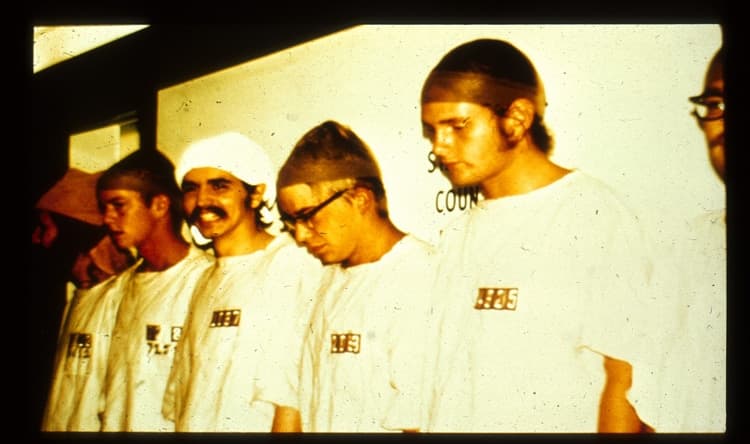
The Stanford Prison Experiment, long cited as proof that situations drive ordinary people toward cruelty, has been substantially discredited by archival evidence, ethical failures, and coached participant behavior, but the genuine psychological question it raised about how environments and systems shape behavior and identity remains clinically meaningful territory for therapeutic self-reflection.
Everything you learned about the Stanford Prison Experiment in psychology class might be wrong. What actually happened inside that basement laboratory, and what it really says about human nature and evil, is far more nuanced, more troubling, and more hopeful than the famous headline ever let on.
The Experiment: Setup, Procedure, and What Actually Happened
In August 1971, psychologist Philip Zimbardo launched one of the most talked-about studies in the history of social science. Conducted at Stanford University and funded by the U.S. Office of Naval Research, the Stanford Prison Experiment (SPE) set out to answer a deceptively simple question: does the environment of a prison change the people inside it, regardless of who those people are? What followed over the next six days would shock observers, end careers, and spark a debate that researchers are still having today.
Recruitment, Screening, and Random Assignment
Zimbardo and his team placed a newspaper ad seeking male college students to participate in a study on prison life. Seventy-five people responded. From that pool, 24 were selected after being screened for psychological stability, physical health, and a clean criminal record. The goal was to start with a baseline of mentally healthy, ordinary young men so that any behavioral changes could be attributed to the situation rather than pre-existing traits.
Once selected, participants were randomly assigned to one of two roles: guard or prisoner. The random assignment was deliberate and critical. On day one, there was no meaningful psychological difference between the two groups. They were, for all practical purposes, the same kind of person wearing a different label.
The Mock Prison Environment and Role Design
The basement of Stanford’s Jordan Hall was transformed into a functional mock prison. Small cells lined the corridor, a converted closet served as solitary confinement (called “the Hole”), and a narrow hallway became the prison yard. The physical space was designed to feel real, because Zimbardo believed that environment shapes behavior in ways people rarely notice.
Costumes reinforced the psychological divide. Guards received khaki uniforms, reflective sunglasses that prevented eye contact, and wooden batons. Prisoners wore loose smocks, stocking caps meant to simulate shaved heads, and ankle chains. Most significantly, prisoners were stripped of their names and assigned ID numbers. These details were not decorative. They were tools for reshaping identity.
Zimbardo himself took on the role of prison superintendent, overseeing the experiment from the inside. That dual role, serving as both the lead researcher and an active participant in the prison’s authority structure, would later become one of the most serious criticisms of the study’s design.
Six Days of Escalation: A Day-by-Day Overview
The experiment was planned to run for two weeks. It lasted six days.
Within the first 36 hours, guards began imposing punishments that were never part of the original protocol. Prisoners were forced into stress positions, deprived of sleep, denied bathroom access, and subjected to arbitrary rules enforced with escalating aggression. Some guards appeared to genuinely enjoy the control. Others went along without objection.
On day two, prisoners staged a revolt, barricading themselves inside their cells. Guards responded by using fire extinguishers to force them back. That same day, a prisoner identified in records as #8612, later revealed to be Douglas Korpi, experienced a dramatic emotional breakdown, screaming and crying uncontrollably. He was released from the study.
By days three and four, most prisoners had become passive and withdrawn. Several showed signs of acute psychological distress. The guards, meanwhile, grew more inventive in their use of power.
The experiment ended on day six, not because Zimbardo called a halt on his own, but because of outside pressure. Graduate student Christina Maslach visited the prison, observed the conditions, and told Zimbardo directly that what she was seeing was wrong. Zimbardo later credited her objection as the moment that broke through his own immersion in the superintendent role and allowed him to see the experiment clearly. The study was shut down the following morning.
What those six days revealed, and whether they revealed what Zimbardo claimed, is where the real debate begins.
Key Findings: What Zimbardo Claimed the Study Revealed About Human Nature
Zimbardo’s central argument was straightforward but striking: you don’t need to be a bad person to do terrible things. According to his interpretation, the situation itself, specifically the roles, rules, and power structures built into an institution, shapes behavior far more powerfully than individual character. He called this the situationist thesis, and the Stanford Prison Experiment became its most famous proof of concept.
The guards in the study had been screened beforehand and found to be psychologically healthy, ordinary college students. Yet within days, many of them began issuing humiliating orders, disrupting prisoners’ sleep, and using psychological intimidation. Zimbardo interpreted this shift as evidence that the guard role itself produced the cruelty. In his view, the uniform, the authority, and the institutional structure did the work. The person wearing them almost didn’t matter.
On the other side of that dynamic, the prisoners, also screened as mentally healthy before the study began, showed rapid psychological deterioration. Several experienced emotional breakdowns. Others became passive and compliant in ways that Zimbardo described as learned helplessness, a state in which people stop resisting because they come to believe their actions have no effect on their circumstances. He argued that powerlessness alone could cause psychological disintegration within a matter of days.
This framing positioned the SPE as a direct challenge to what Zimbardo called dispositionist explanations of evil. The dispositionist view holds that atrocities happen because certain people are simply cruel, disturbed, or morally defective, the “bad apples” theory. Zimbardo flipped this: the barrel itself is what turns apples bad. Ordinary people placed inside corrupt systems, he argued, will behave corruptly.
Zimbardo pushed this logic well beyond the basement of Jordan Hall. He drew explicit connections between the SPE and real-world atrocities, including the abuse of detainees at Abu Ghraib, the Holocaust, and other cases of institutionalized cruelty. In each instance, he argued, the structure enabled and even encouraged the behavior.
The original findings were published in a 1973 academic paper, but Zimbardo’s interpretation reached its widest audience through his 2007 book The Lucifer Effect: Understanding How Good People Turn Evil. The book cemented the SPE as a cornerstone of introductory psychology courses and popular science writing, making Zimbardo’s situationist thesis one of the most widely repeated claims in the behavioral sciences.
What the Guards Actually Said: Primary Source Testimony That Complicates the Narrative
The Stanford Prison Experiment’s most enduring claim is that ordinary people, when placed in positions of power, will naturally become cruel. Several of the people who were actually there, though, tell a different story. Their retrospective accounts, some given decades later, raise serious questions about whether what Zimbardo filmed was genuine psychological transformation or something closer to performance.
Dave Eshelman: “I Was Playing a Character”
Dave Eshelman, the guard who earned the nickname “John Wayne” for his especially aggressive behavior, has been candid about what was really driving his actions. In later interviews, Eshelman explained that he consciously modeled his conduct on the sadistic prison warden in the film Cool Hand Luke. He wasn’t losing himself in a role; he was deliberately constructing one. Eshelman said he escalated his cruelty because he believed that was what the researchers wanted to see, and he wanted to help produce meaningful results. That’s not role absorption. That’s a participant trying to be a good subject.
Douglas Korpi: The Breakdown That Wasn’t
Perhaps the most iconic moment of the entire experiment is Prisoner #8612, Douglas Korpi, sobbing and screaming to be let out. It became a defining image of the study’s power. In 2018, journalist Ben Blum reported that Korpi admitted the breakdown was largely faked. Korpi said he needed to get out of the experiment so he could study for his graduate school exams, and he performed distress to secure his release.
This account isn’t just Korpi’s word against Zimbardo’s. Le Texier’s 2019 archival analysis examined audio recordings from the experiment and found that Korpi could be heard speaking in a calm, measured voice between his emotional outbursts, at points explicitly negotiating the terms of his release. The recordings suggest a person managing a situation, not one overwhelmed by it.
The Briefing Tape: Zimbardo’s Instructions to the Guards
The same archival analysis uncovered something equally significant: recordings of Zimbardo’s pre-experiment briefing to the guards. He told them they could create “boredom, frustration, fear… a sense of powerlessness” in the prisoners. That language reads less like a neutral experimental protocol and more like a director giving notes before a scene. When participants are told what emotional atmosphere to produce, the behaviors that follow cannot be cleanly attributed to the situation alone.
Other participants gave mixed accounts over the years. Some reported genuine distress and disorientation. Others described a persistent awareness that they were in an experiment, not a real prison, and shaped their behavior accordingly. What emerges across these testimonies is a spectrum, ranging from authentic psychological impact on one end to calculated performance on the other. Researchers call the latter demand characteristics, meaning participants behave the way they believe the researchers expect them to. The SPE, it turns out, may have been full of both.
Ethical Failures and What They Changed About Research Standards
The Stanford Prison Experiment didn’t just raise questions about human behavior. It exposed serious failures in how researchers were permitted to treat the people who trusted them enough to participate. Those failures left a lasting mark on the field of psychology, not because they were unique, but because they were so well-documented.
What Went Wrong, and How Badly
Participants signed consent forms before the study began, but those forms never disclosed that real Palo Alto police officers would arrest them at their homes without warning. That surprise arrest was deliberately designed to create disorientation, which means the distress it caused was not incidental. It was the point. This violated the spirit of informed consent, which requires that participants understand, in meaningful terms, what they are agreeing to experience.
What followed inside the simulated prison was worse. Several participants showed signs of severe emotional distress: uncontrollable crying, fits of rage, and disorganized thinking. These are responses consistent with acute psychological trauma, and traumatic disorders of this kind can have lasting effects that extend well beyond the original event. Despite visible signs of deterioration, participants were not immediately removed from the study. The experiment continued.
Zimbardo’s role made meaningful oversight impossible. He served simultaneously as the study’s principal investigator and as the prison’s superintendent, a dual role that created a direct conflict of interest. His investment in the experiment’s dramatic results compromised his duty of care to the people under his supervision. There was no independent voice in the room asking whether participants were safe.
No formal ethics review body equivalent to today’s Institutional Review Board existed at Stanford in 1971. The SPE predated modern IRB protocols entirely, and the outcry it generated helped push those structures into existence.
How the SPE Reshaped Research Ethics
The American Psychological Association’s current ethical guidelines, outlined in Section 8 on Research and Publication, now require researchers to conduct ongoing assessments of participant welfare throughout a study. Participants must also retain the right to withdraw at any time, without penalty or pressure. The SPE violated both principles. The documented harm participants experienced, including responses that align with what we now understand about psychological trauma, is precisely why these protections exist today.
The experiment is now a standard case study in research ethics courses, used not to celebrate bold science, but to illustrate exactly what institutional safeguards are designed to prevent.
Critical Evaluation: Why the Study Is Scientifically Contested
The Stanford Prison Experiment is one of the most cited studies in psychology, but citation frequency is not the same as scientific validity. Over the decades, researchers have raised serious concerns about the study’s design, the data Zimbardo chose to highlight, and whether participants were actually behaving spontaneously at all. Taken together, these critiques suggest the experiment’s sweeping conclusions about human nature rest on a much shakier foundation than its fame implies.
Methodological Flaws: Sample, Controls, and Experimenter Bias
The study began with 24 participants, split into two groups of 12. That sample size is far too small to draw universal conclusions about how all people respond to power and authority. The group itself was also narrow in ways that matter: participants were almost entirely white, male, college-aged men who responded to a newspaper ad specifically seeking volunteers for “a study of prison life.” That kind of self-selection likely attracted people with a higher tolerance for conflict or an appetite for intense experiences, which means the sample may have been predisposed to dramatic behavior before the study even began.
The experiment also lacked a control group. Without a comparison condition, there was no way to isolate whether the prison environment itself was causing behavioral changes, or whether other variables, like group dynamics, sleep deprivation, or simple boredom, were at play. Perhaps the most glaring problem is that Zimbardo served simultaneously as the study’s lead researcher and as the prison’s superintendent, a fundamental conflict that makes objective data collection impossible.
The One-Third Problem: The Data Zimbardo Downplayed
Even setting aside the design flaws, the experiment’s own findings don’t cleanly support its conclusions. Zimbardo himself reported that guards fell into roughly three groups: about one-third were cruel and abusive, one-third were strict but fair, and one-third actively tried to help prisoners. This breakdown directly undermines the central situationist claim that the guard role itself produces cruelty. If the situation were truly the dominant force, you would expect far more uniform behavior across the group. The variation Zimbardo documented but minimized in his public narrative tells a more complicated story, one where individual character still played a significant role.
Demand Characteristics and Coached Behavior
Participants knew they were in an experiment, and that knowledge shapes behavior in ways that are difficult to control for. Psychologists call this “demand characteristics,” meaning participants pick up on cues about what researchers expect and adjust their actions accordingly. Former guard Dave Eshelman later admitted he deliberately modeled his behavior on a film character, and Douglas Korpi confirmed that his distress was partly performed because he believed that was what the situation called for.
The most damaging evidence came in 2019, when researcher Thibault Le Texier published an archival analysis in American Psychologist revealing that Zimbardo’s team had actively coached guards to be more aggressive. Cruelty did not emerge organically from the situation. It was, at least in part, prompted. Critics like psychologist Erich Fromm had raised concerns about the study as early as the 1970s, but those objections were largely ignored until replication attempts in the 2000s brought renewed scrutiny. The debate today is not just about whether the study was ethical. It is about whether its conclusions were ever scientifically earned.
The BBC Prison Study: What a Replication Attempt Found Instead
In 2002, psychologists Alex Haslam and Steve Reicher set out to revisit the Stanford Prison Experiment’s core claims under far more rigorous conditions. Partnering with the BBC for independent observation and applying stronger ethical oversight, their study became the most significant empirical challenge to Zimbardo’s conclusions. When the results were published in 2006, they told a strikingly different story.
The most immediate divergence was in how the guards behaved. Rather than slipping into authoritarian roles, many guards were visibly uncomfortable with the power they had been given and reluctant to use it. There was no uniform drift toward cruelty. The situation alone did not produce domineering behavior, which directly contradicted the SPE’s central argument that role assignment was enough to reshape how people act.
The prisoners, meanwhile, did not become passive or broken. They organized, communicated, and built collective resistance that ultimately destabilized the guard structure entirely. According to research on the psychology of tyranny from this BBC Prison Study, the outcome was the opposite of what Zimbardo had described.
Haslam and Reicher proposed social identity theory as a more accurate explanatory framework. This theory holds that people adopt group norms when they genuinely identify with the group they belong to, but that identification is not automatic or inevitable. Simply assigning someone a label does not guarantee they will internalize it.
This distinction carries real weight. The BBC study suggested that tyranny is not a mechanical product of situations. It requires active construction: leaders must persuade group members that cruelty is legitimate, normal, and expected. Without that psychological work, the situation alone does not reliably produce harm.
Zimbardo dismissed the BBC study as incomparable to the SPE. Haslam and Reicher pushed back, arguing that their more controlled design had actually revealed what the SPE’s flaws had hidden all along.
The Unraveling Timeline: How the SPE Went from Textbook Gospel to Cautionary Tale (1971–2024)
The Stanford Prison Experiment did not collapse overnight. Its fall from scientific grace unfolded across five decades, shaped by competing researchers, a global replication crisis, and ultimately a pair of archival investigators who found evidence the original team never wanted scrutinized.
- 1971–2000: Uncritical acceptance. For nearly thirty years, the SPE appeared in virtually every introductory psychology textbook as settled proof that situations shape behavior. Thousands of academic papers cited it. Documentaries, news segments, and pop-psychology books treated Zimbardo’s conclusions as fact. Students learned about the experiment the same way they learned about gravity: as something already proven.
- 2001–2006: The first cracks. Researchers Steve Reicher and Alex Haslam ran the BBC Prison Study in 2002, a rigorously filmed replication that produced strikingly different results. Guards did not inevitably become brutal. Prisoners organized and resisted. Their peer-reviewed findings challenged the SPE’s core situationist claim and signaled that the original study’s conclusions were far from universal.
- 2013–2017: The replication crisis arrives. Social psychology was shaken when researchers found that many of its most famous findings could not be reproduced. The SPE’s methodological weaknesses, its tiny sample, lack of controls, and Zimbardo’s dual role as researcher and prison superintendent, drew renewed and sharper scrutiny.
- 2018: The archival bombshell. Journalist Ben Blum published an investigative piece revealing recorded evidence that guards had been coached by experimenters. French researcher Thibault Le Texier’s book Histoire d’un mensonge (History of a Lie) presented archival documentation showing participants were, in part, performing roles they had been directed to play. The public narrative shifted decisively.
- 2019–2024: Institutional reckoning. Le Texier’s critique appeared in American Psychologist, the APA’s flagship journal, lending the deconstruction full academic legitimacy. Major textbook publishers began adding critical caveats or reframing the SPE as a lesson in flawed methodology. When Zimbardo died in October 2024, obituaries wrestled openly with his complicated legacy.
What this timeline reveals is that science does self-correct, but slowly, unevenly, and often through journalists and archivists rather than the researchers closest to the original work.
Why It Still Matters: Legacy, Real-World Impact, and What the SPE Teaches Us About Ourselves
The Stanford Prison Experiment may be scientifically discredited, but its cultural footprint is undeniable. Zimbardo testified before U.S. congressional hearings on prison reform in the 1970s, and decades later he served as an expert witness during the Abu Ghraib military tribunal, arguing that situational forces shaped the soldiers’ behavior. The study also inspired two major films, The Experiment (2010) and The Stanford Prison Experiment (2015), and it remains a staple of introductory psychology courses worldwide.
Today, the SPE’s greatest value may be what it teaches about critical thinking and scientific literacy. It shows how a deeply flawed study can be accepted as truth for decades when it confirms what people already believe. That lesson alone is worth carrying forward.
The core question the SPE raised still deserves serious attention: how much of your behavior is shaped by the situations and systems around you versus who you truly are? Research on how stress shapes behavior confirms that environments, whether toxic workplaces, controlling relationships, or rigid institutions, can influence how you think, feel, and act in ways that aren’t always easy to recognize from the inside.
Self-reflection tools like therapy, journaling, and mood tracking can help you notice those patterns before they take hold. If you’ve been thinking about how your environment shapes the way you feel and act, talking to a therapist can help you explore that. You can start with a free assessment on ReachLink, no commitment required, entirely at your own pace.
What You Take From This Says Something Real About You
Reading about the Stanford Prison Experiment can leave you sitting with an unsettling question: how much of who you are is actually you, and how much is the environment you are in? That question is not abstract. It shows up in difficult workplaces, in relationships where you do not quite recognize yourself, in moments when you act in ways that feel out of character and cannot fully explain why. The science is more complicated than the textbooks once suggested, but the underlying concern, that systems and situations shape us in ways we do not always see, is worth taking seriously.
If you have been thinking about how your surroundings affect the way you feel, think, or treat others, that kind of self-reflection is genuinely valuable and does not have to happen alone. You can explore what therapy looks like with a free assessment on ReachLink, no commitment required, entirely at your own pace, whenever you feel ready.
FAQ
-
Why did the Stanford Prison Experiment show that normal people can do terrible things?
The Stanford Prison Experiment, conducted in 1971, found that ordinary college students assigned to play prison guards quickly began behaving in cruel, authoritarian ways - not because they were inherently bad, but because the situation itself shaped their behavior. This revealed a key psychological insight: our environment, roles, and social expectations can override our personal values more easily than most of us realize. Psychologists call this the situational explanation of behavior, as opposed to assuming that only certain types of people are capable of harm. Understanding this doesn't excuse harmful behavior - it helps us recognize warning signs and stay more intentional about how our roles and environments shape us.
-
Can therapy help me if I feel like my circumstances are slowly changing who I am?
Yes, therapy can be very effective for people who feel their sense of self is shifting due to their environment, relationships, or caregiving roles. Approaches like Cognitive Behavioral Therapy (CBT) help you identify the thought patterns and situational pressures that influence your behavior, while therapies like Acceptance and Commitment Therapy (ACT) help you reconnect with your core values. A therapist can also help you develop healthier boundaries so that external pressures have less power over your identity. Many people find that simply having a consistent, reflective space to process their experiences helps them feel more grounded and authentic.
-
Does taking on a caretaker role actually change your personality over time?
Research in psychology, including insights drawn from studies like the Stanford Prison Experiment, suggests that roles we inhabit for long periods can meaningfully shape our behavior, emotional responses, and even our sense of self. Caregivers in particular often experience what's called role absorption, where the demands of caring for another person gradually crowd out their own needs, preferences, and identity. This isn't a personal failure - it's a natural response to sustained situational pressure. Recognizing this pattern is the first step toward reclaiming a stronger, more balanced sense of who you are outside of your caregiving role.
-
I think I need to talk to someone about how my role is affecting me - where do I even start?
Starting is often the hardest part, and reaching out for support is a genuinely courageous step. ReachLink connects you with licensed therapists through human care coordinators - real people who take the time to understand your situation and match you with a therapist who fits your needs, rather than an algorithm making that decision for you. You can begin with a free assessment that helps identify what kind of support would be most helpful for you. From there, you can meet with your therapist through secure video sessions from wherever you feel most comfortable. Taking that first step doesn't require having everything figured out - it just requires showing up.
-
What can I actually do to stop my environment from controlling how I act?
One of the most effective strategies is building what psychologists call psychological flexibility - the ability to notice situational pressures without automatically acting on them. Practices like mindfulness, reflective journaling, and setting clear personal values can help create a buffer between the pressures around you and your responses to them. Therapy, particularly CBT or values-based approaches, gives you structured tools to identify when your environment is pulling you away from who you want to be. Small, intentional choices - like naming your values, checking in with yourself regularly, and seeking outside perspective - can make a real difference over time.