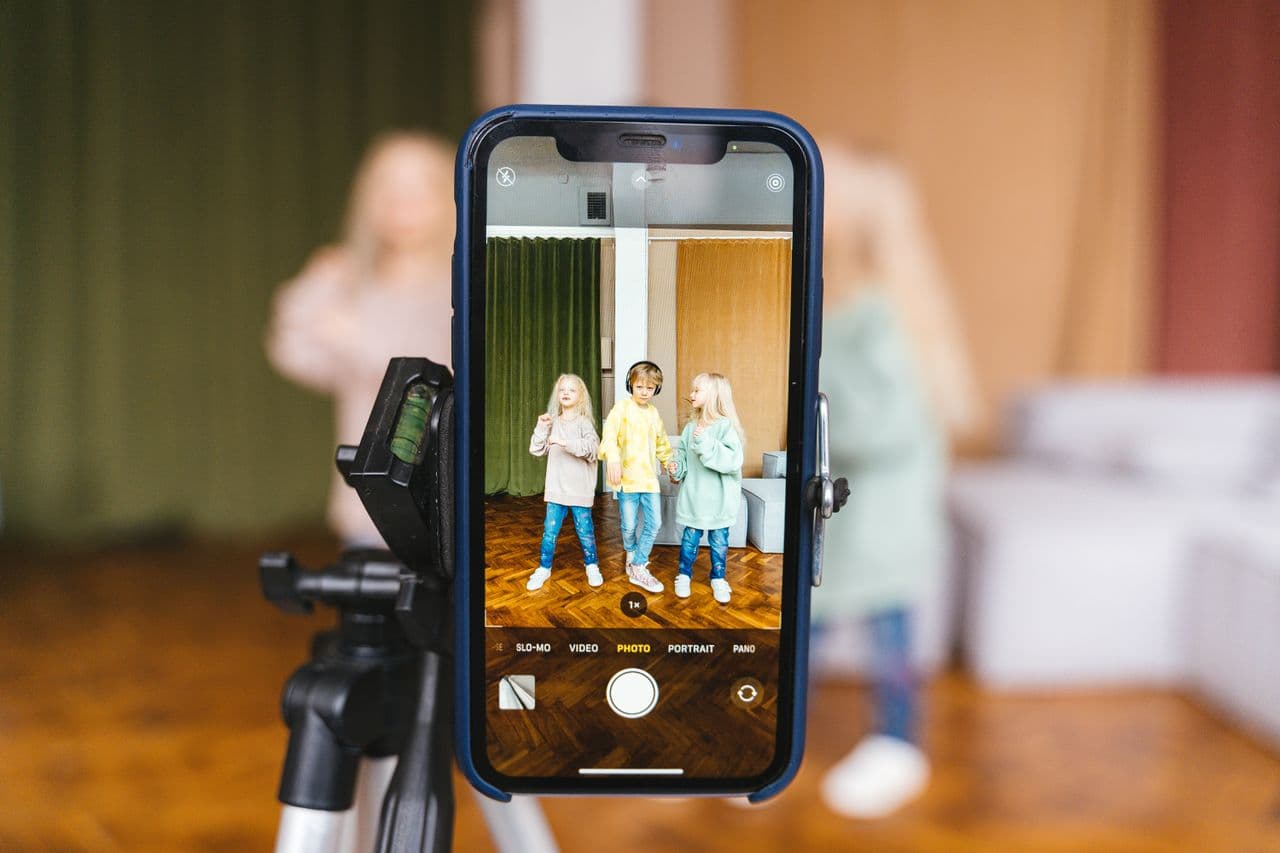
Growing up as a child content creator can blur identity development, parentify kids financially and emotionally, and erode privacy in ways that raise anxiety and lower self-esteem, but family therapy and trauma-informed care help parents and children rebuild healthy boundaries, restore genuine consent, and separate self-worth from audience approval.
What happens to a child's sense of self when their tantrums, bad days, and bedtime routines become content for strangers? Growing up as a content creator can quietly reshape identity, trust, and privacy long before a child understands what they agreed to. Here's what parents need to know, and how support can help.
Most worry about kids online focuses on scrolling, but child content creator mental health raises a different question: what happens when a childhood is produced for an audience. Identity, privacy, attention, and family roles can all shift once a child’s daily life becomes the product. This article covers what can change, the signs worth watching, and the support that can help.
When a childhood becomes content
A child who posts an occasional video is not the same as a child whose daily life is the product. The distinction that matters for this article is between consumption and production: most research and most parental worry is about kids scrolling and watching, but a smaller and newer group of children spend their childhood being watched. That second group is what this article is about, and it needs some shared vocabulary before anything else.
A kidfluencer is a minor whose image, voice, or daily life generates an online audience, often with brand deals or ad revenue attached. Family vlogging refers to channels built around a household’s everyday life, where a child’s bedtime, meals, or meltdowns become recurring segments rather than private moments. A parent-managed account is any profile where an adult controls the posting, responds to comments, and makes decisions about what gets filmed, even when the account is framed as the child’s own. A monetized minor is a child whose content generates income, whether that income goes toward savings, family expenses, or a business run in the child’s name.
This is the detail that separates child content creation from typical childhood: output made on a schedule, for an audience, often for money. Ordinary childhood moments, a tantrum in the car, an awkward growth spurt, a stomach bug, become retrievable public records instead of things that fade into family memory. Feedback on that record arrives constantly and in numbers, so a child learns early to read likes and views as a running scorecard of their own worth. This happens during years when identity is still being built, the same years creator work asks a child to hold a consistent public persona. Whether kids should be social media influencers at all is a newer question than screen-time research was built to answer, because most of that research studies children watching content, not children producing it for other people to watch.
Child-led or parent-led: the distinction that changes everything
Two children can post the same kind of video: a room tour, a dance, an unboxing. One is having fun on a Tuesday afternoon. The other is clocking in. From the outside, through a phone screen, the two look identical. The difference is not in the footage. It is in who the content is actually for, and whether the child could walk away from it without anything in the household changing.
What child-led participation actually looks like
Child-led participation looks like a kid who can stop mid-video, lose interest halfway through a series, or decide next week that the whole thing is boring now. The mood at dinner does not shift because of it. Nobody tracks whether this week’s numbers are down. The question “should kids be social media influencers” assumes a fixed category, but the more useful question is whether a given child is directing the activity or being directed by it, session by session.
How compliance gets mistaken for enthusiasm
Parent-led creation often looks exactly like enthusiasm, because agreeable children get rewarded for agreeing. A child who smiles on command, repeats a line on request, or shows up for filming without protest can read as a kid who loves the camera. That smile might be real affection for the activity. It might also be a learned response to keep a parent calm, which is a very different thing wearing the same face. How impressionable children are to the emotional tone around them is part of what makes this so hard to see from outside the family.
Why a child’s consent works differently than an adult’s
A child’s yes to a parent is not the same transaction as an adult’s yes to an employer, because the parent also controls affection, approval, and basically the whole household. Saying no to a parent risks more than saying no to a boss does. That asymmetry is what makes consent here worth examining closely rather than taking at face value.
One way to tell a real yes from compliance is whether it survives a no. Does the child still want to film after being told they do not have to? Does the willingness hold up through boredom, a bad day, a sibling fight an hour earlier? A yes that shows up instantly, echoes the parent’s own phrasing, or evaporates the moment the parent leaves the room is closer to compliance than choice. None of this means the child is miserable. Enjoyment and harm are not opposites here: a child can genuinely like being filmed and still be shaped by a structure that never gave the no anywhere to go. A systematic scoping review of social media’s impact on children’s mental health found that moderate, more autonomous use supports positive social interaction, while frequent use tied to lower self-esteem and anxiety tends to involve less of that autonomy, which is consistent with agency, not just screen time, being the variable that matters.
The mental health costs that show up most often
Growing up as a content creator touches several areas of development at once: identity, attention, appearance, and privacy. Each one carries its own cost, and the impact of social media and technology on child and adolescent mental health tends to concentrate in these four places.
Identity and the always-on persona
When a child’s self is built for an audience, the performed version can become more practiced than the private one. A camera-ready persona gets rehearsed daily: certain reactions land, certain phrases get praise, and the child learns which version of themselves performs best. Over time that performance can stop feeling like a performance at all.
Michael Drag, LPC describes how this works at the level of inner speech: “our internal monologues, if you have an internal monologue, it doesn’t have a different voice. It doesn’t have a different sound. It sounds like us. And so when we internalize someone else’s voice, it becomes our voice.” Natasha D’Arcangelo, QS, LMHC, NCC, CCTP, CCFP makes a related point about where that voice comes from: “the things that we model for them and the way that we speak to them ends up becoming the way that they speak to themselves.” For a child whose words, reactions, and even mistakes are shaped for public consumption, that modeling includes the audience, not just the adults around them. This is part of why identity-related harm from a childhood spent creating content can resemble low self-esteem: the critical or performative voice a child absorbs did not start inside them.
Attention, feedback loops and shortened focus
Short-form content runs on a particular rhythm: post, wait, check, repeat. A child whose work is built around that cycle learns to expect fast feedback, and the gap between posting and response becomes a measure of worth rather than a neutral pause. This is one version of how social media affects children’s attention span: the habit of checking is trained early and often, by the job itself rather than by incidental scrolling. A schedule built around engagement cycles asks a developing brain to treat likes, views, and comments as information it needs right away.
Appearance, comments and public scrutiny
For a child creator, appearance scrutiny starts earlier than it would for a peer and comes from strangers rather than classmates. Social media beauty standards and mental health are already linked for teenagers who simply use these platforms: a study of 763 adolescents and young adults found that preoccupation with appearance-related content on social media is more strongly associated with depression, social anxiety, and appearance rejection sensitivity than general social media use alone. For a child whose appearance is also tied to income, that preoccupation is not optional. A study of 210 adolescent girls found that time spent on appearance-related comparisons online predicted poorer body image, and comment sections put that comparison in front of a child who does not yet have the perspective to discount a stranger’s opinion.
Privacy that cannot be taken back
A child who is filmed, posted, and discussed cannot try on an identity in private the way most children do. Ordinary experimentation, an awkward phase, a bad haircut, a mood that passes, happens in front of an audience and often ends up archived. Filming schedules and locations can also separate a child from unstructured time with peers, trading ordinary social life for content production. None of this disappears when the child grows up: footage posted at six or eight can resurface in adolescence or adulthood, found and shared by classmates who were never meant to see it. That kind of exposure, with no ability to consent to it at the time, is one reason some of what gets discussed under childhood trauma includes experiences that look nothing like a single bad event.
Parentification and the family business problem
Most child performers go home after the set closes. Child content creators often cannot, because the set is the home. When a household’s income depends on a child’s output, the child is no longer just a participant in family life. The child becomes responsible for whether the bills get paid, which is a different weight than remembering lines or hitting a mark.
This is parentification, and it runs on two tracks at once. Financially, the child’s performance keeps the household running. Emotionally, the child learns to manage the family’s mood and stability, sensing when a parent is anxious about numbers and adjusting energy, enthusiasm or compliance to meet it. Research on boundary dissolution between parent and child roles describes how this blurring of who is responsible for whom reshapes the relationship itself, not just the workload inside it.
The role confusion compounds the problem. A parent who is also manager, editor, director and negotiator has no off-duty version of themselves to offer. Every interaction can carry a trace of the business, even bedtime, even a birthday. The child has no equivalent off-duty version either: withdrawing effort has visible consequences for someone they love, which makes saying no to a shoot feel like letting a parent down rather than setting a boundary.
Siblings do not share this weight evenly. The child who performs well, who gets the views, the brand deals, the algorithm’s attention, can become the household’s de facto provider, while a sibling who draws less engagement occupies a different and sometimes resentful position. None of this requires a cold or exploitative household to take hold. A family can be warm, affectionate and genuinely loving while still running on a structure where a child’s labor underwrites everyone’s stability, which is part of why the dynamic is so hard to see from outside and so hard to name from inside. These patterns overlap with what shows up more broadly in family caretaker dynamics, where a child’s role tips from being cared for to doing the caring, with consequences for child influencers’ mental health that often surface only years later.
Who owns the money and who owns the footage
Platform rules on minors and monetization
Should kids be social media influencers in the first place is a question platforms never had to answer, because the decision belongs to parents, not to any regulator. Major platforms set their own minimum ages for who can own an account and who can earn from one, and family channels featuring minors run under those platform rules rather than under any labor code. Platform policies focus on advertiser suitability and child safety settings: what content can carry ads, what features get restricted for accounts flagged as child-directed. None of them guarantee a child any share of what that content earns. A Duke University thesis on children of influencer parents found that children central to a channel’s profitability have no financial rights to earnings generated from their own name, image, and likeness, despite being the reason the channel earns anything at all.
Where earnings protections exist and where they do not
Traditional child entertainment law, the Coogan laws written for film and television, requires a portion of a child performer’s earnings to be set aside in trust until adulthood. Those statutes were built for soundstages and studio contracts, not for a bedroom with a ring light. The same Duke thesis notes that existing protections, including Coogan laws, COPPA, and the Fair Labor Standards Act, were not written with monetized family content in mind and leave a regulatory gray area around online creator earnings. A small number of states have extended trust or earnings protections to cover online content featuring minors. Most have not, which means a child’s legal protection depends heavily on which state they happen to live in. Separate from earnings, a handful of statutes include right-to-delete or content-removal provisions, letting a person request that footage of their childhood come down once they are old enough to ask. A Columbia Journal of Law and Social Problems note on publicity rights proposes expanding this into a formal right to deletion for adults who grew up in monetized family content.
Why the legal gap has a psychological cost
Child influencers’ mental health outcomes are shaped partly by this gap itself. A child who later learns their image generated real income they never saw, and never controlled, often reinterprets the whole of their childhood once they understand what was actually happening.
What children can genuinely gain from creating
The question of whether kids should be social media influencers does not have a single answer, because the activity itself can build real skill. A child who plans a video, shoots it, edits it, and sees it through to publishing is practicing planning, sequencing, and follow-through the same way a child practices those skills finishing a school project or a craft. Writing scripts, pacing a story, and learning basic editing software are transferable abilities, not throwaway internet skills. Some children also pick up technical and organizational habits, like managing a content calendar or tracking what worked, that look a lot like early work experience.