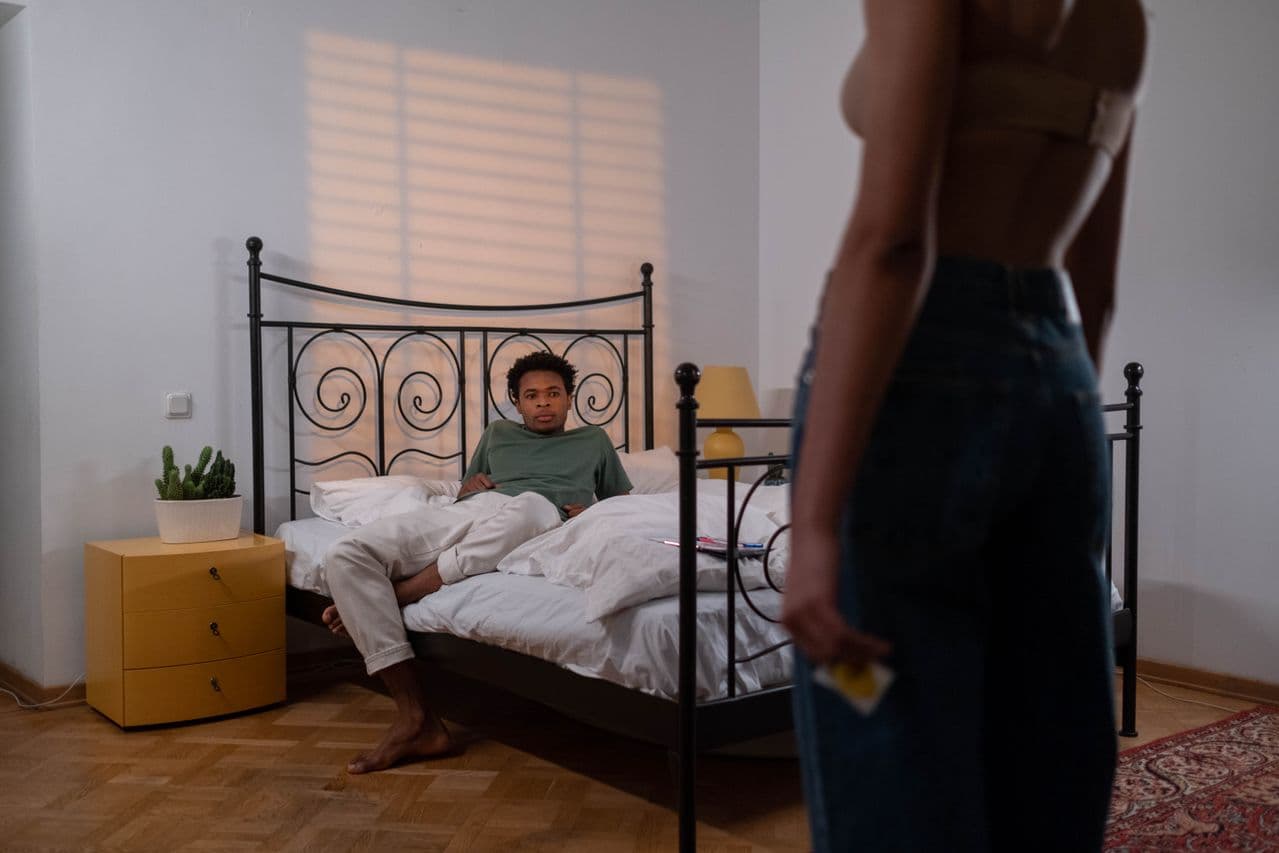
Sexual performance anxiety traps individuals in a neurologically driven cycle where fear of failure directly suppresses arousal through the brain's sexual inhibition system, but evidence-based therapeutic interventions, including cognitive behavioral therapy, sensate focus therapy, and mindfulness training, can break that cycle at each identifiable stage.
Trying harder to overcome sexual performance anxiety does not help - it makes the failure more certain. That is not a personal weakness, it is your brain's own threat system running exactly as designed. This article breaks down the neuroscience, the cycle, and how to interrupt it for good.
Your brain’s sexual accelerator and brake: why anxiety shuts down arousal
Sexual arousal is not simply a matter of desire. It is the net output of two competing neurological systems working against each other at the same time. Researchers John Bancroft and Erick Janssen developed the Dual-Control Model to explain this, and it reframes everything about why anxiety and arousal cannot coexist.
The first system is the Sexual Excitation System (SES), your brain’s accelerator. It responds to erotic cues, novelty, and feelings of safety by pushing arousal forward. The second is the Sexual Inhibition System (SIS), your brain’s brake. It scans constantly for threats, including self-monitoring, social evaluation, and fear of failure. When the SIS detects a threat, it does not nudge the brake gently. It slams it.
Performance anxiety is, neurologically speaking, a threat signal. Your brain does not distinguish between the fear of embarrassing yourself in bed and the fear of physical danger. Both activate the same stress response. Anxiety symptoms like racing thoughts, hypervigilance, and self-monitoring flood the SIS at full force, overwhelming whatever excitation the SES was building. Research on anxiety-related sexual dysfunction mechanisms supports this directly: threat perception and self-monitoring are neurologically grounded drivers of sexual inhibition, not just psychological noise.
The physical consequences follow a clear chain of events. Anxiety triggers the sympathetic nervous system, the system responsible for fight-or-flight. Blood flow is diverted away from the genitals and toward large muscle groups so the body can respond to the perceived danger. Genital arousal, whether erection or lubrication, depends on the opposite state: a calm, parasympathetic nervous system. The two cannot run simultaneously.
This is where low self-esteem compounds the problem. Self-judgment and perceived inadequacy are among the most potent SIS activators in the dual-control model. The moment you begin evaluating your own performance, you hand the brake even more power.
None of this is a willpower failure. Your body is doing exactly what it was designed to do under stress. The failure you feared was not caused by weakness. It was caused by a hardwired neurological system responding precisely as intended.
The effort paradox: why trying harder guarantees failure
There is a cruel irony at the heart of sexual performance anxiety: the harder you try to perform, the less likely you are to succeed. This is not a character flaw or a sign that something is deeply wrong with you. It is a predictable outcome explained by a well-established psychological principle.
Psychologist Daniel Wegner described what he called ironic process theory. The idea is straightforward: when you consciously try to suppress or force a mental state, your brain simultaneously launches a background monitoring process to check whether you are succeeding. Try not to think about a white bear, and you will think about almost nothing else. The monitor, designed to detect failure, ends up producing it.
Applied to sex, the effect is immediate and concrete. The moment you tell yourself “I need to stay aroused,” a part of your mind begins scanning for evidence that you are not. That scanning is a cognitive task, and cognitive tasks pull your attention away from physical sensation. Arousal depends on absorption, on being present in your body and senses. Monitoring is the opposite of absorption. You cannot check whether you are in the moment and also be in the moment.
This explains something many people notice but struggle to articulate: the times they felt no pressure, everything worked naturally. There was no monitor running, so the involuntary process of arousal unfolded without interference.
The ironic process does not operate alone, either. The monitoring activates a sense of threat, threat triggers the brain’s inhibition system, inhibition suppresses arousal, and reduced arousal confirms the original fear. Each part of the cycle feeds the next, and the attempt to fix the problem becomes the engine keeping it running.
What is sexual performance anxiety?
Sexual performance anxiety (SPA) is persistent worry about your ability to perform sexually. That worry does not stay in your head. It triggers a stress response that directly interferes with the physical processes behind arousal, erection, lubrication, orgasm, and desire. The result is a self-reinforcing loop: fear of failure produces the very failure you feared.
According to research on sexual performance anxiety prevalence, SPA affects an estimated 9–25% of men and 6–16% of women, though the true rate in women is likely higher because this population has historically been under-researched. It shows up across all genders, sexual orientations, and relationship structures.
SPA does not appear as a standalone diagnosis in the DSM (the Diagnostic and Statistical Manual of Mental Disorders, which clinicians use to classify mental health conditions). As both the prevalence research and a review of SPA across genders confirm, it is recognized instead as a significant contributing factor to several formal sexual dysfunction diagnoses.
It also affects far more than erections. SPA can present as:
- Anorgasmia: difficulty reaching orgasm
- Premature ejaculation: climaxing sooner than desired
- Vaginismus: involuntary tightening of vaginal muscles
- Arousal disorders: reduced physical response to sexual stimulation
- Sexual avoidance: withdrawing from intimacy entirely to sidestep the fear
SPA can also be situational, appearing only with certain partners or in specific contexts, or generalized, affecting nearly all sexual experiences. Knowing which pattern fits your experience matters, because the two often call for different approaches.
The 7-stage performance anxiety cycle: where the loop breaks down and how to interrupt it
Sexual performance anxiety does not appear out of nowhere the moment things go wrong. It builds across a precise sequence of stages, each one feeding the next. Understanding where you are in that sequence is what makes interruption possible.
Stages 1–3: Before and early — where prevention lives
Stage 1: Anticipatory dread (hours or days before)
The cycle often starts long before anyone enters a bedroom. Your mind begins generating catastrophic predictions: What if I can’t perform? What if it happens again? These thoughts feel like facts, but they are not. The intervention here is cognitive defusion, a technique from cognitive behavioral therapy that teaches you to name a thought as a thought rather than a prophecy. Instead of “I’m going to fail,” the reframe becomes: “I’m having the thought that I’m going to fail.” That small linguistic shift creates distance between you and the fear.
Stage 2: Contextual priming (entering the sexual context)
As the situation becomes real, your nervous system shifts into hypervigilance. You start scanning your partner’s face for signs of expectation, reading the room for pressure cues. The body is already bracing. Two interventions work here: sensory grounding (orienting attention to physical sensations like breath, temperature, or touch) and agreed-upon low-pressure entry rituals with a partner. A ritual might be as simple as a few minutes of non-sexual physical closeness before anything else begins. It signals safety to the nervous system before arousal is even on the table.
Stage 3: The internal check-in (early arousal phase)
This is the first self-monitoring scan: Am I aroused yet? Is it working? The moment you ask that question, you have stepped out of the experience and into evaluation mode. The evidence-based response is sensate focus redirection, a practice that deliberately moves attention away from genital response and toward the full sensory experience of touch. Arousal follows attention, not the other way around. Checking for it interrupts the very process that produces it.
Stages 4–5: The in-the-moment crisis point
Stage 4: Spectatoring (during sexual activity)
Spectatoring is the clinical term for dissociating from your body and watching yourself from the outside, as if you are a critic in the audience of your own experience. It is one of the most well-documented mechanisms in sexual dysfunction research. The intervention is interoceptive anchoring: slow, deliberate breathing patterns that activate the parasympathetic nervous system (your body’s rest-and-recover state). Specifically, exhaling longer than you inhale signals physiological safety and pulls attention back inside the body.
Stage 5: The tipping point (arousal falters)
Physiology confirms the fear. This is the moment the cycle feels most inevitable. A planned verbal script with your partner can break the frame entirely. Something simple and pre-agreed, like “Let’s slow down and just be close for a minute,” removes the performance context without requiring explanation or apology. What you say matters less than having something ready so silence does not become its own catastrophe.
Stages 6–7: After — where the next cycle gets built or broken
Stage 6: Catastrophic interpretation (immediately after)
The “I knew this would happen” narrative solidifies fast. This is where a single event gets fused with identity: not “that was difficult” but “I am broken.” Cognitive restructuring, the practice of separating what happened from the story you build around it, is the direct intervention. The event is data. The identity story is a conclusion you are choosing, and it can be unchosen.
Stage 7: Avoidance encoding (hours or days after)
This is the stage most people overlook, and it is the most consequential. The brain files the experience as evidence, quietly seeding Stage 1 of the next cycle. A structured written reflection, not journaling about feelings but specifically reframing the encounter beyond a binary of success or failure, disrupts that filing process. What went well? What felt connected? What was one moment of genuine sensation? These questions train the brain to encode complexity instead of confirmation.
Causes and triggers of sexual performance anxiety
Sexual performance anxiety rarely has a single cause. It tends to grow from a mix of thought patterns, relationship dynamics, cultural messages, and personal history, each one capable of tipping the nervous system toward inhibition at exactly the wrong moment.
Cognitive roots sit at the center of many cases. Research on psychological factors as cognitive roots of sexual performance failure identifies perfectionism, diminished self-esteem, and all-or-nothing thinking about sexual adequacy as core drivers of psychogenic sexual difficulty. When someone believes that anything short of a flawless experience means they are fundamentally inadequate, the pressure that belief creates can shut down arousal on its own. Body image concerns follow a similar path: worries about genital appearance, weight, or aging pull attention inward and activate the sexual inhibition system, the brain’s brake described in the dual-control model above.
Relational triggers are equally powerful. New partners introduce evaluation apprehension, a fear of being judged that overlaps closely with social anxiety presentations. Unresolved conflict, perceived dissatisfaction from a partner, or a history of infidelity can all prime the inhibition system before a sexual encounter even begins.
Cultural and societal pressure sets impossible standards. Masculinity scripts tie erection directly to manhood, while femininity scripts frame a partner’s orgasm as proof of skill. Penetration-centric definitions of sex leave little room for difficulty without shame. Studies on internet pornography and sexual dysfunction suggest that pornography-informed expectations raise the bar for the excitation system while simultaneously activating inhibition through performance comparison.
Historical factors complete the picture. Sexual trauma, shame-based religious upbringing, early negative sexual experiences, and prior episodes of difficulty can each create the anticipatory dread that launches the self-defeating cycle.
Signs your sexual difficulty is anxiety, not a physical problem
Not every sexual difficulty has the same root cause, and knowing what is driving yours matters. Several patterns strongly suggest anxiety is the primary culprit rather than a physical condition. None of these are definitive on their own, but together they paint a clear picture.
Morning or nighttime erections are still happening. If you wake up with an erection regularly, your vascular and hormonal systems are functioning as they should. The issue is not the hardware; it is the context. Performance anxiety tends to surface specifically in high-stakes moments, not during sleep when the evaluating mind is switched off.