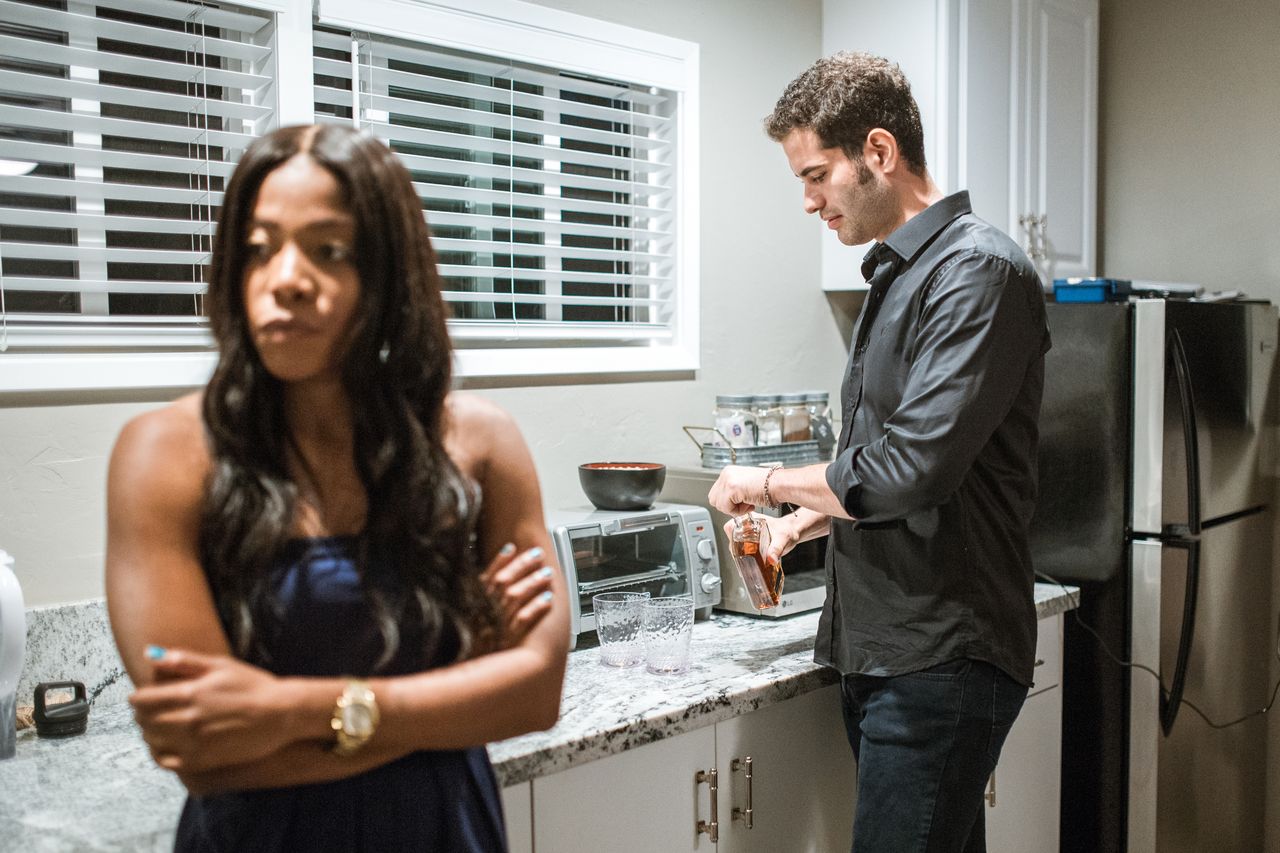
A boyfriend turning cold around friends usually reflects social anxiety, learned restraint from male friend group dynamics, or divided attention rather than a loss of feeling, and licensed couples or individual therapy can help identify which pattern is occurring and build healthier communication when the coolness does not resolve on its own.
What actually happens in the split second his hand slips out of yours when friends walk in? This boyfriend acting distant pattern feels personal, but it rarely is. Here's what's really going on in that room, and how to tell if it's harmless or worth addressing.
Why does my boyfriend act different around his friends than with me?
The pattern usually looks like this: he is warm, talkative, maybe affectionate when it is just the two of you, and then his friends walk in and something shifts. His hand slips out of yours. His answers get shorter. He stops looking at you while he talks, or he steers the conversation somewhere impersonal the second it starts to feel like your business. If you have thought “my boyfriend doesn’t talk to me when he’s with his friends,” this narrower version of the pattern is usually what you mean, not that he ignores you outright, but that he seems to put something down the moment an audience shows up.
What makes it confusing is that nothing actually changed between you two. You said nothing wrong, the relationship feels the same five minutes earlier and five minutes later, so the shift reads as rejection instead of what it more often is: a change tied to the room, not to you.
It helps to separate two different things people mean when a boyfriend seems distant. One is situational: he is closer, cooler, more guarded specifically around his friends, and reverts back once you’re alone again. The other is broader, where the distance shows up everywhere, including when it’s just the two of you. Those point in different directions, and telling them apart starts with noticing where the coolness actually lives.
Some of this is just ordinary code-switching, the common habit of adjusting your tone, vocabulary, and warmth depending on who’s in the room. Everyone does a version of it. The question worth sitting with is how far that adjustment goes, and whether it ever brushes up against something like social anxiety rather than simple social calibration.
What is usually going on underneath it
A few explanations show up again and again when a boyfriend acts warm in private and cool in a crowd. None of them require anything to be wrong with your relationship. If you have been asking yourself why your boyfriend is being distant all of a sudden the moment his friends walk in, one of these is probably closer to the truth than whatever story you have been telling yourself at 1am.
One common pattern is social anxiety in groups. Managing a room full of people, tracking who said what, reading the mood, deciding when to speak, takes real effort for some people. That effort has to come from somewhere, and it often comes from the same reserve he would normally spend being warm toward you. The affection has not disappeared. It is just being outspent by the room.
Another is learned restraint. In a lot of male friend groups, visible tenderness toward a partner gets treated as material for teasing rather than something to be shown openly. A guy who reaches for your hand or laughs easily with you at home may hold back in front of friends simply to avoid becoming the joke for the next ten minutes. Related to that is the fear of being seen as the friend who changed since getting a girlfriend, which can push him to overcorrect into coolness he does not actually feel.
Some of it is not emotional at all. A number of people genuinely cannot hold a group conversation and a private connection at the same time. Splitting attention between his friends and you is not the same as withdrawing from you, even if it looks similar from where you are sitting.
And sometimes the flatness has nothing to do with either of you. Unresolved friction inside the friend group itself can make him go quieter and more guarded whenever those particular people are in the room.
These are common explanations, not a diagnosis of your specific boyfriend. A boyfriend acting distant but still saying he loves you can be telling the truth about both things at once. The only way to know which of these fits him is to ask directly, without assuming the answer first.
How this shows up differently depending on who is in the room
If you’ve thought “my boyfriend doesn’t talk to me when he’s with his friends,” the next useful question is which friends. Not every group pulls the same version of him out. Treating “his friends” as one category hides the pattern that would actually tell you something.
Old friends versus work friends versus everyone at once
Old friends from childhood or high school often pull a person back into an earlier version of themselves, including an earlier, cruder way of showing affection. He might go quiet with you in that room simply because the joking, ribbing version of him from age sixteen has resurfaced, not because anything between you has shifted. Work colleagues tend to bring out something else: a more careful, formal version, where the coolness is about managing how he looks professionally rather than about you at all. Mixed groups with other couples usually loosen him up again, and that’s worth noting as information, not as a pass or fail test he either meets or doesn’t.
One person can matter more than the crowd
Size isn’t usually the driver. One dominant personality in a group, someone louder, more teasing, or more competitive, can change his behavior more than whether the room holds four people or fourteen. If he’s warm in most groups and cold in exactly one, the variable worth looking at is probably that group, or that one person in it, not the two of you.
Build the habit of noticing before concluding
Before you draw any conclusion, try tracking which rooms this happens in and which it doesn’t. Notice the setting, who else is there, and how long it takes for him to loosen up or not. That pattern will tell you more than any single evening will.
The social pressure men carry into a room full of other men
Many men grow up with a specific split: warmth toward a partner is fine behind closed doors and fair game for mockery in front of friends. That lesson does not disappear just because the relationship is good. If your boyfriend acting distant but says he loves me is a pattern you recognize, part of what you are seeing may be that old split still running in the background, not a sign that anything between you has changed.
Teasing inside male friend groups often zeroes in on exactly the things that show closeness: a soft nickname, a quick check-in text, an obvious inside joke with a girlfriend. Getting razzed for those moments teaches a reflex, and the reflex is to flatten out anything that could be pointed at. It is less a decision than a habit, the same way you might stand up straighter walking into a job interview without consciously choosing to.
Some men are also doing two things at once in that room: managing how they come across to their friends and managing you, at the same time. Splitting attention between status in the group and warmth toward a partner is hard, and plenty of guys are not smooth at it. That is why he may genuinely not recognize what you are describing when you bring it up later. The shift usually is not calculated. It is closer to bracing than to choosing.
None of this means you have to accept being treated coldly in front of other people. Understanding where the reflex comes from changes how you open the conversation, not whether the conversation needs to happen.
Is this normal, or is it a red flag?
Not every quiet boyfriend is hiding something. The difference usually shows up in the pattern, not the mood, and the pattern is something you can actually observe over a few gatherings.
Signs it is shyness or social habit
If what you are seeing is social anxiety, it tends to look even. He goes quiet with everyone in the room, not just around you, and the same discomfort shows up whether his friends are there or not. He might avoid eye contact, give short answers, or hang back near the door regardless of who invited him. That evenness matters: withdrawal that touches the whole room reads as anxiety, not as coolness aimed at you specifically. Learned restraint also tends to come with repair. He reconnects with his friends later, or he can notice out loud that he went quiet, or he can hear you name it calmly without getting defensive.
Signs it is concealment or control
Concealment looks different because it targets the relationship, not the room. Watch for being introduced vaguely or not introduced at all, for your relationship staying out of conversations with people who clearly already know about it, or for plans somehow always changing so you and his friends never end up in the same place. Irritation when you speak, rather than simple quietness, is another marker worth taking seriously. So is consistency: does what he tells his friends about you match what he tells you he says? If you are asking yourself why my boyfriend is distant but says nothing is wrong, or noticing that he has started acting distant and ghosting you around specific people, that gap between the two stories is often where the answer lives.
The repair test: what happens after
Instead of trying to rate how bad it is, test whether repair is possible. After the event, can the two of you talk about what happened without him treating your question as an attack? Warmth alone, coolness in public, and hostility when you ask about the gap between them is no longer a friend group problem. A pattern of contempt, isolation from your own support network, or pressure to keep the relationship invisible sits in a different category from shyness, and it deserves to be named as such rather than explained away.
How to bring it up without putting him on the defensive
Choosing the moment and the opening line
Skip the car ride home. That’s when the details are freshest, but it’s also when he’s least able to hear anything without feeling ambushed, and neither of you has anywhere to go if it gets tense. Wait a day or two instead, while the specifics are still clear enough to describe, and pick a moment when you’re both calm and alone. Open with the moment itself, not the pattern: “When we got to the party and you barely said hi to Mark” lands very differently than “you’re always so distant with your friends.” A single described moment is harder to wave off than a character judgment, because it’s a fact he was actually there for.
Asking for something specific instead of something general
Before you say what you think happened, ask what the evening was like for him. He may genuinely not have noticed the shift, and starting with a question instead of a conclusion gives him room to find it himself. Then name the impact on you plainly, without needing him to agree on why he does it: “I felt kind of alone standing there” doesn’t require him to admit intent, just to hear the effect. From there, ask for one small, specific change rather than a general promise to be warmer. A greeting when you arrive, or a check-in halfway through the night, is something he can actually do and you can actually notice.
If he says nothing is wrong
If your boyfriend is distant but says nothing is wrong, and the pattern keeps repeating anyway, that refusal to talk about it is worth naming on its own. You can say directly that the silence itself feels like part of the problem, separate from whatever is causing the standoffishness. If he answers with something like “I love you, I’m just like this in groups,” you can take that as sincere and still hold onto your specific request. Those two things aren’t in conflict: he can be telling the truth about who he is and still be capable of a check-in text or a hello at the door. If you’re a girlfriend whose boyfriend is distant but doesn’t want to break up either, this is usually the middle ground worth trying before anything bigger, and couples therapy can give you both a structured place to have this conversation if it keeps stalling out on your own.
When it is worth getting outside support
Some patterns work themselves out with time and a few honest conversations. Others do not, and it helps to know the difference before you spend another year waiting for something to shift on its own. A reasonable threshold looks like this: you have raised it clearly, more than once, he understands exactly what you are describing, and nothing has changed. If your boyfriend seems distant every time friends are around and that has not moved after real conversations, the issue is no longer awareness. It is something else, and awareness was never going to fix it.
A second threshold is about the conversation itself. If bringing it up now ends in stonewalling, contempt, or the same fight on repeat, the topic has become the problem, separate from whatever caused the original distance.
Individual support is worth considering even if the relationship is not in crisis, especially if this is stirring up an older fear about being hidden or not fully chosen. That fear deserves its own attention regardless of what he does next. If the pattern involves concealment, distance from your own friends and family, or quiet pressure to stay invisible in his life, individual support first is the more protective choice. Wanting to be acknowledged in public is a reasonable need, not neediness.
Couples support makes sense when you both want the relationship and keep circling the same unresolved conversation without either of you being able to break the loop alone. If you are wondering whether your boyfriend is distant but does not want to break up, that ambiguity itself is worth talking through with someone. You can create a free ReachLink account and browse licensed therapists at your own pace, with no commitment.
What you have noticed about him is not your imagination
Watching your boyfriend soften only around you can bring up a strange mix of comfort and worry, like you are holding information you do not quite know what to do with. It makes sense to wonder whether his guardedness with others says something about his past, his sense of safety, or the way closeness feels earned rather than given freely. None of this means you are responsible for fixing it, and it does not mean the relationship is doomed either. Sometimes the clearest way to understand a pattern like this is to talk it through with someone trained to notice what is underneath it, especially if it is affecting how secure you feel together. Couples and individual counseling can help you sort out what belongs to him, what belongs to you, and what the two of you might work through side by side. If you want support thinking this through, you can begin with a free assessment at ReachLink, done privately and at your own pace, with no commitment attached.
FAQ
-
Why does my boyfriend act so differently around his friends than he does when we're alone?
This is a very common pattern, and it usually comes down to a mix of social pressure, learned habits, and how much mental energy group settings demand. Many men grow up in friend groups where showing tenderness toward a partner can invite teasing, so they develop a reflex to pull back in public even when the relationship feels solid in private. It can also be a focus issue, since managing a group conversation genuinely uses up the same emotional reserve that normally goes toward being warm with you. The shift often has more to do with the room than with how he feels about you, but that does not mean it is something you have to simply accept without talking about it.
-
How do I tell if my boyfriend going quiet around his friends is just a social habit or something I should actually be worried about?
The difference usually shows up in the pattern rather than any single moment. Social anxiety or learned restraint tends to be even - he pulls back from everyone in the room, not specifically from you, and he can reconnect and talk about it afterward without getting defensive. A more concerning pattern looks different: being introduced vaguely or not at all, your relationship being kept out of conversations with people who clearly already know about it, or irritation when you speak rather than just quietness. If the public version of him and the private version of him tell two different stories about your relationship, that gap is worth paying close attention to.
-
Can couples therapy actually help if my boyfriend shuts down around his friends and refuses to talk about it?
Couples therapy can be genuinely useful when the two of you keep circling the same conversation without being able to move it forward on your own. A licensed therapist can help both of you slow down the pattern, name what is actually happening underneath it, and figure out what each person needs from the other. Therapy approaches like CBT or talk therapy give couples a structured way to surface habits - like learned social restraint - that are hard to see clearly from inside the relationship. Even if your boyfriend is skeptical, starting with a few sessions can open up the kind of honest conversation that tends to stall when you try to have it on your own.
-
I think my relationship needs outside support - how do I find a therapist who actually gets relationship stuff?
Finding the right therapist for relationship issues can feel overwhelming, but starting with a platform that does the matching work for you makes it much more manageable. ReachLink connects people with licensed therapists through human care coordinators - not an algorithm - so the match is based on your actual situation rather than a filter quiz. You can start with a free assessment at your own pace, with no commitment attached, and a care coordinator will help you find a therapist with real experience in relationship dynamics and communication patterns. Whether you want individual support to work through how this is affecting you, or couples therapy to have the conversation together, a licensed therapist can help you figure out what fits.
-
Is it normal to feel like I'm not fully chosen just because my boyfriend acts differently around other people?
Yes, that feeling is very common and makes complete sense. When someone is warm with you behind closed doors but seems to put that warmth away the moment others arrive, it can trigger a deeper fear about whether you are truly accepted or somewhat hidden. That fear deserves its own attention, separate from whatever is going on with him, because the feeling of not being fully chosen often connects to older experiences around visibility, belonging, and security. Individual therapy can be a good place to untangle what belongs to the current relationship and what might be an older wound that this situation is bringing to the surface.