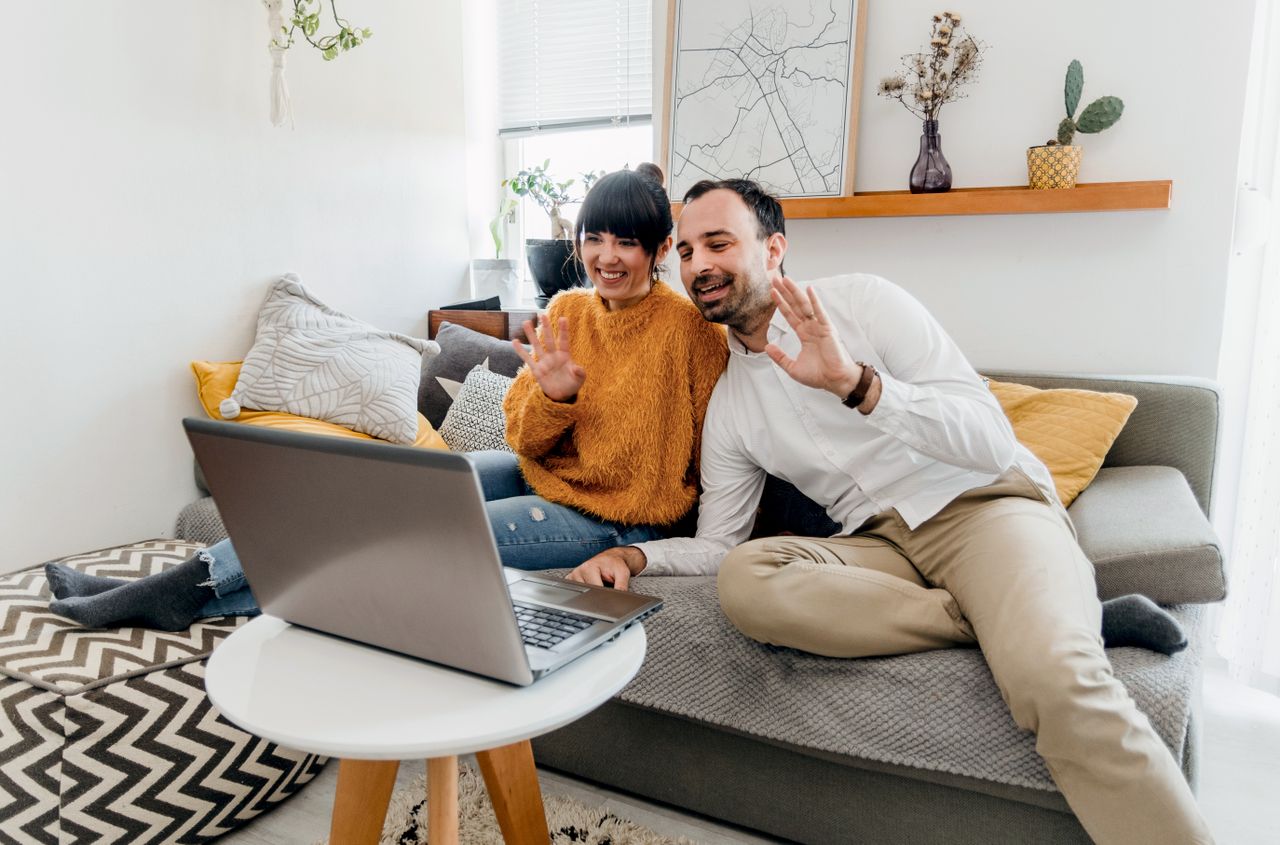
Online couples therapy on a shared couch works by having both partners join one video session through a single device, with a licensed therapist guiding seating and turn-taking to replace in-person cues, producing relationship satisfaction outcomes comparable to face-to-face sessions.
What happens when two people have to share one camera, one mic, and one screen during a hard conversation? Online couples therapy on the same couch comes with its own quirks, from seating to interruptions, and knowing what to expect can turn an awkward setup into one that actually works for you.
Online couples therapy is often pictured as two people in two boxes, but many couples join from the same couch on one device. This article is for couples considering that setup. It covers how a shared-device session works, where to sit, when separate devices make more sense, how to handle interruptions, and what the research says about whether online couples therapy works.
How online couples therapy works when you are both on the same couch
How does online couples therapy work when you are both on the same couch? Both partners log into one account on one device, join the video room together, and show up on screen in a single shared frame instead of two separate boxes. The session itself still follows a familiar structure: a check-in, a conversation guided by the therapist, and time at the end to plan next steps. What changes is the logistics of sharing one camera, one microphone, and one screen between two people who are sitting right next to each other. Telehealth delivery has become a well established part of how couple therapy is practiced today, so a shared-device setup is not an improvised workaround but a format many couples now use by default.
Before the session: account, scheduling, and who sets up the room
One partner usually creates the account and books the appointment, though either person can do it. Before the first online couples therapy session, the therapist typically asks who will be in the room, whether anyone else in the house can overhear, and what each partner hopes to get out of the work. This gives the therapist a clear picture of the setup before the conversation starts. Whoever is more comfortable with the technology often takes the lead on getting the laptop or tablet positioned and the video room open, but that role can shift week to week.
Inside the session: how the hour is usually structured
With both faces in one shared frame, the therapist cannot rely on eye contact alone to show who they are speaking to, so they tend to say each partner’s name more often than they would in an in-person room. Turn-taking also becomes more explicit: the therapist might say directly that it is one partner’s turn to speak and ask the other to hold their response for a moment. This is not about enforcing rules for their own sake. It simply replaces the physical cues that get lost when two people share a single tile on a screen.
After the session: what you take with you
Most shared device couples therapy sessions end with a short wrap-up, sometimes including a conversation or exercise to continue between appointments. Couples often carry a specific topic, a reflection, or a note from the therapist into the days that follow, and into the next session. None of this requires special software beyond what is used during the appointment itself. You can read more about how online couples therapy fits into ongoing care between sessions.
For the tech itself, a stable laptop or tablet at eye level works better than a handheld phone, since it keeps both of you in frame without someone holding the device. Headphones are usually skipped so both partners hear the same audio at the same time.
Where to sit: facing the camera or facing each other
For virtual couples counseling setup, the default position is side by side, both facing the camera. This seating choice has a practical reason behind it: it lets the person leading the session see both faces at the same time, including the small reactions that happen while one partner is talking and the other is just listening. A wince, a nod, a look away. Those reactions are part of the conversation, and side by side keeps them visible.
Sometimes you will be asked to turn and face each other instead, usually in a moment when one of you is asked to say something directly to the other rather than about them. That shift in direction is itself a tool, separate from the usual seating arrangement, and worth naming here even though the handling of that moment belongs elsewhere.
Distance matters too. Couples therapy seating on a shared couch often reveals a default gap neither partner had noticed, and seeing it on screen can be its own small piece of information.
A few physical details change the conversation more than people expect. A device set below face level reads as looking down at the people on the other end. One set too far back flattens expression until it is hard to read. Light should come from in front of both of you, not from behind, so neither face falls into shadow.
One more thing worth naming: if only one partner is holding the phone or angling the laptop, that person ends up controlling what the screen shows and when it moves. That control is small, but it is real.
Same device, separate devices, or separate locations
Couples joining online couples therapy from the same couch usually fall into one of three setups, and each one changes the audio, the privacy, and what the therapist can see. None of these is more correct than another. The right fit depends on your home, your schedule, and sometimes the topic for that week.
Same device, same room
This is the simplest setup: one laptop or tablet, one shared microphone, both partners in frame together. It is the easiest to coordinate since there’s only one login and one camera angle to manage, and it tends to feel more like sitting together than dialing in separately. The trade-off is audio. A single microphone picks up whoever speaks louder or sits closer, so the quieter partner can get lost in the mix, especially when both of you talk at once.
Separate devices, same home
Here each partner logs in from their own device, often from different rooms, giving each of you your own frame and your own microphone. This setup for online couples therapy with separate devices helps when one partner tends to speak over the other, since the therapist hears both voices at an even volume. It does create feedback or echo if you are within earshot of each other without headphones, so headphones are what make this configuration actually work.
Separate devices, separate locations
This is the setup for travel, deployment, or any stretch where you are not physically together, which is also what makes long distance couples counseling online possible at all. Each partner gets full privacy and their own space to speak freely. What gets lost is the shared-room read: the glance one partner gives the other, the shift in posture when a subject lands, cues a therapist would otherwise pick up without either of you saying a word.
What is the difference between online and traditional couples therapy?
The difference is logistics, not substance: you choose how you connect (one screen, two screens, or two locations) while the structure of the session itself stays the same. Many couples do not pick one configuration and stick with it. They move between setups depending on the week, the topic, or simply who is traveling.
Signs a session may need separate devices
A shared screen works until it doesn’t, and the signs tend to show up in how the conversation actually moves. One partner’s voice carries over the other on a single microphone, so words get lost before they land. One partner answers a question that was addressed to the other, or finishes their sentence before they get the chance. These are not abstract concerns about communication style. They are audible, visible things that happen inside the hour.
Some signals are quieter. A partner glances at the other before answering a direct question, as if checking for permission to speak. A particular topic comes up and one partner goes flat or silent, and the silence doesn’t lift for the rest of the session. One partner holds the device, controls the camera angle, or sits closest to the mute button, which quietly decides who gets heard and when.
Sometimes the issue isn’t the dynamic between partners at all. It’s online couples therapy privacy: one partner has something to raise that they are not ready to say out loud in the same room, even with the door closed. That need for a private line is reasonable on its own and doesn’t require anything to be wrong with the relationship.
In practice, a switch can look like couples counseling separate rooms, each partner on their own device with headphones, or an individual check-in added into the session structure. None of this signals failure. It’s a practical adjustment to how the conversation needs to move that day.
Managing interruptions during a shared couch session
Online couples therapy at home means the session happens wherever your life already happens, and that includes the doorbell, the dog, and a toddler who picks the worst possible moment to need you. The disruptions are real, but most of them are manageable with a little planning and a shared understanding of what to do when something comes up.
How do you prepare for online couples therapy?
Prepare by treating the hour before the session like you would before leaving the house for an appointment. Arrange childcare if you can, or at least have a plan for where kids will be. Put pets in another room, let any expected deliveries get flagged or rescheduled, and set both phones face down and on silent. This kind of setup does more to prevent couples therapy interruptions than anything you do once the session starts.
Handling the interruptions that still happen
Agree with your partner and your therapist, ahead of time, on a pause signal. A simple phrase or hand gesture means a break reads as a break, not as one partner walking out of a hard conversation. If a child comes into the room, name it out loud, pause instead of muting and talking off-mic, then pick the conversation back up where you left it. If interruptions keep happening session after session rather than occasionally, that pattern itself is worth raising in the room, since it often says something about how you both handle interruption outside of therapy too. Finally, agree on a backup plan for a dropped connection in your first session, so a frozen screen never gets mistaken for someone leaving.
What a shared couch setup makes easier
What are the benefits of online couples therapy?
The main benefits of online couples therapy come from logistics and context lining up at the same time. One commute, one babysitter, one block of time carved out of a shared evening, instead of two separate schedules that both have to survive a drive across town. That alone removes one of the most common reasons sessions get rescheduled or skipped. Virtual couples counseling benefits show up most clearly for couples whose calendars rarely match.