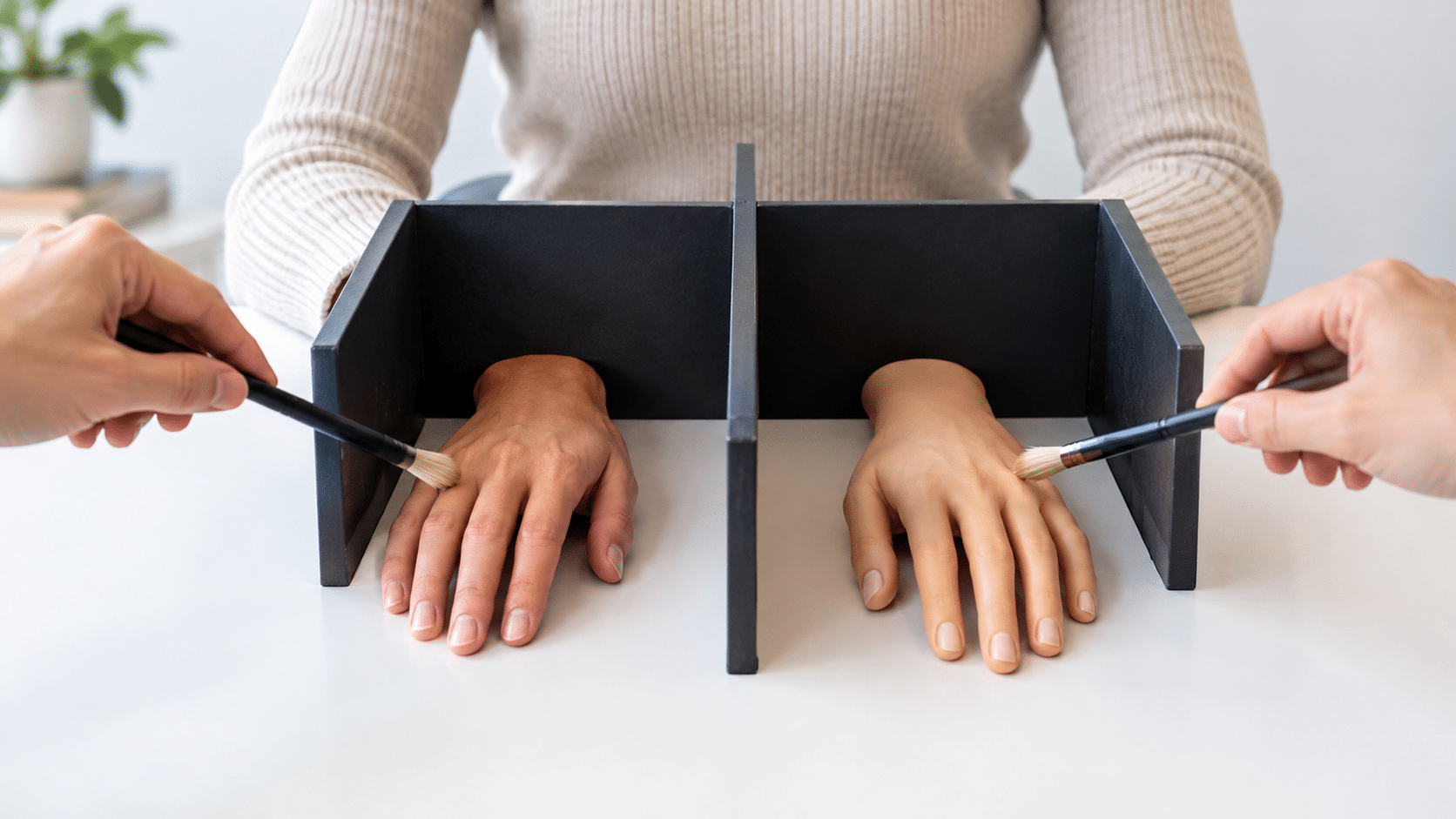
The rubber hand illusion demonstrates that your brain builds body ownership from synchronized sight and touch rather than fixed anatomy, revealing why sensory conflict can trigger depersonalization or distorted body image, and why persistent detachment from your own body often benefits from guidance by a licensed therapist trained in body-based approaches.
What if your brain doesn't actually know which hand is yours? The rubber hand illusion proves that body ownership is a story your brain builds from touch and sight, not a fixed fact. Here's what that reveals about feeling disconnected from your own body, and when it's worth getting support.
What the rubber hand illusion is
The rubber hand illusion is a simple lab demonstration that changes how you feel about your own hand. A participant sits with one real hand hidden from view and a lifelike rubber hand placed in front of them, positioned roughly where their real hand would be. Someone strokes the rubber hand and the hidden real hand at the same time, using the same brush, at the same rhythm. Within a short period, many people report the rubber hand starting to feel like it belongs to them, and they describe the touch as if it were happening on the fake hand rather than their own.
That handoff of sensation from a real body part to a fake one is the whole effect. Researchers Botvinick and Cohen first described it in a 1998 report published in Nature, and labs have replicated the finding many times since. The headline result is straightforward: the felt boundary of your body is not fixed by anatomy alone. It can be reassigned in minutes, using nothing more than synchronized touch and a plausible visual stand-in.
What is the fake hand experiment?
The fake hand experiment is a test of how your brain decides which objects count as part of your body. It works by pairing what you see happening to a rubber hand with what you feel happening to your real one, hidden out of sight. A few terms from this setup come up repeatedly, so it helps to define them here.
Body ownership is the felt sense that a given body part is yours, distinct from simply knowing it belongs to you. Embodiment is the broader experience of taking something, a rubber hand or otherwise, into that felt sense of your own body. Proprioception is your internal sense of where your limbs are in space without needing to look at them, and it is the sense that gets pulled off course during the illusion, a shift researchers call proprioceptive drift. Together these terms describe a body that is built moment to moment rather than simply given.
How the illusion is actually run
The setup depends on hiding the truth from your eyes while your other senses stay online. Your real hand rests out of view, usually behind a screen or under a table edge. A rubber hand sits in front of you, positioned where a real hand could plausibly attach to your arm. A drape or a strip of fabric covers the seam where the fake wrist meets your sleeve, so there is no visible gap that would give away the trick.
Synchronous versus asynchronous stroking
Once you are positioned, a researcher strokes both the hidden real hand and the visible rubber hand with a small brush. In the synchronous condition, the strokes land on matching spots at the same time and in the same rhythm, so what you see happening to the rubber hand matches what you feel happening to your own. In the asynchronous condition, the timing or location is deliberately mismatched. The asynchronous version is not a throwaway comparison. It keeps every physical element of the setup identical (the hand, the brush, the drape, the room) and changes only the timing, which is what lets researchers say that any difference between conditions comes from the match between sight and touch rather than from something else in the environment.
How the effect gets measured
After the stroking, participants usually complete a standardized questionnaire asking whether the rubber hand started to feel like their own, and how strongly. That gives a subjective report, but researchers also want a number that does not depend on someone accurately describing an internal feeling. This is where proprioceptive drift comes in: with eyes closed, participants point to where they believe their hidden hand is, and under the synchronous condition that pointing tends to shift toward the rubber hand’s actual position. Other measures used in the research literature include how a person’s body reacts when the fake hand appears to be threatened, and physiological changes such as skin conductance. A study measuring skin conductance response when a threat was directed at the rubber hand found that the body reacted as though the fake hand were under genuine physical threat, giving researchers a measure that sits outside conscious report entirely.
What the illusion reveals about how your brain builds a body
Most of the time, vision, touch and proprioception (your sense of where your limbs are without looking) agree completely about where your hand sits. You never notice this agreement because there is nothing to notice. The signals line up so smoothly that the question of whose hand is whose never even arises. That seamlessness is the whole point, and it is also what makes the illusion possible.
The rubber hand illusion works by breaking that agreement on purpose. Your eyes report that a paintbrush is touching a rubber hand sitting on the table. Your skin reports that the same touch is happening on your real hand, hidden a few inches away. The brain will not hold both reports side by side and shrug. It resolves the conflict, and research on the neural basis of body ownership shows that vision frequently wins that resolution: the felt location of the touch drifts toward the seen hand, and with it comes a sense that the rubber hand belongs to you.
What does the rubber hand illusion tell us?
It tells you that the boundary between self and not-self is drawn by the brain from evidence, not read off your actual anatomy, which is why that boundary can be redrawn. Body ownership, the felt sense that a limb is yours, turns out to be a conclusion rather than a fact stamped onto your skin. It gets reached through multisensory integration, the brain’s ongoing work of combining sight, touch and body sense into one coherent story, and it gets updated continuously rather than fixed once at birth.
That means your body image, the mental picture of where your body is and what it includes, is best understood as a working model. It is accurate almost all the time because the evidence usually agrees. But it is revisable under the right input, and a rubber hand and a hidden paintbrush are enough input to shift it. This is also why the effect reaches beyond a lab table: anything that changes the sensory evidence reaching your brain has the potential to change the felt body along with it, a point that matters well beyond party tricks and shows up in conditions involving distorted body image.
Ownership, agency and location: three questions your brain answers separately
Most descriptions of the rubber hand illusion talk about it as one experience. It is actually three separate judgments running at once, and they can be pulled apart in the lab. Research on self-recognition frames these as sense of body and sense of action, two distinct contributions to how you attribute an action or a limb to yourself. Ownership, agency, and location each ask a different question, and each has its own experiment that isolates it.
Ownership asks whether a hand belongs to you. Agency asks whether you are the one causing it to move. Location asks where the hand feels like it is positioned in space. Ownership shows up as a feeling of belonging, tested with the classic stroking version of the illusion. Agency shows up as a feeling of causing an effect, tested with versions where the participant moves and watches the consequence. Location shows up as a felt position, tested by asking someone to point to where their hand seems to be.
Ownership: is this hand mine?
Ownership is the sense that a hand is part of your body, not just an object near it. This is the piece most people mean when they describe the classic version of the illusion, where synchronized stroking of a hidden real hand and a visible fake one produces a feeling that the fake hand belongs to you.
Agency: am I the one moving it?
Agency, or sense of agency, is the felt sense that you are the author of a movement, distinct from simply owning the limb that moved. Moving versions of the illusion test this directly: a participant moves their own finger, and a fake hand on screen or in view moves along with it. When the visual feedback is delayed or distorted, the sense of causing that movement drops, even though the felt ownership of the hand can stay intact. That gap is the clearest evidence that agency and ownership are separate judgments, not two names for the same feeling.
Location: where does my hand feel like it is?
Location is the felt position of the hand in space, and it does not always move in step with ownership. Across different setups, a person’s sense that the fake hand is theirs and their sense of where their own hand now feels located can rise and fall independently. The two can shift by different amounts, or move in different directions, under the same manipulation.
The distinction matters outside the lab. Someone who says they feel detached from their own actions is describing an agency problem, not an ownership problem, and someone who says a limb does not feel like theirs is describing something else again. Treating those as the same report loses information about what is actually misfiring.
When the illusion breaks, and what that tells us
The illusion does not survive every condition, and the boundary conditions matter more than the effect itself. Each way the illusion fails marks a place where the brain draws a line, and lining up those failures gives a clearer picture of what counts as a body part than any single successful trial does.
Timing is the strictest of these limits. The brain needs the seen touch on the fake hand and the felt touch on the real hand to land close together in time. Research on synchronous versus asynchronous stroking found that the illusion weakens as the delay between the two grows, and past a certain point the asynchrony breaks it entirely. The window is narrow enough that a visible lag between what you see and what you feel is often enough to keep the fake hand feeling foreign.
Posture matters just as much. Rotate the fake hand into an angle your own arm could not physically hold, a wrist bent backward past its natural range, and the effect tends to fade or disappear. The same happens when the fake hand sits too far from where your real hand actually is. Distance and angle both push the fake hand outside what your brain treats as a plausible position for your own limb.
The object itself has to read as a hand, and as your hand specifically. A left hand substituted for a right, or a plain block of wood standing in for a hand, produces a much weaker version of the effect than an anatomically correct rubber hand. Oddly, skin tone mismatches often do less damage than posture does, which suggests plausibility of form carries more weight than surface likeness. Not everyone responds the same way either. Susceptibility varies from person to person, and some people do not experience the illusion at all under conditions that reliably produce it in others.
Taken together, these limits argue against a brain that accepts any visual stand-in for a body part. Anatomical plausibility, timing, and position all have to line up before ownership shifts, which points to a brain testing candidates against a standing model of what a body can be, not a brain absorbing whatever it happens to see.
Where in the brain this gets decided
Neuroimaging work on the rubber hand illusion keeps pointing to the same handful of regions: premotor cortex, posterior parietal cortex, the cerebellum, and the insula. None of these areas work alone. Each seems to handle a different piece of the puzzle involved in treating a rubber hand as your own.