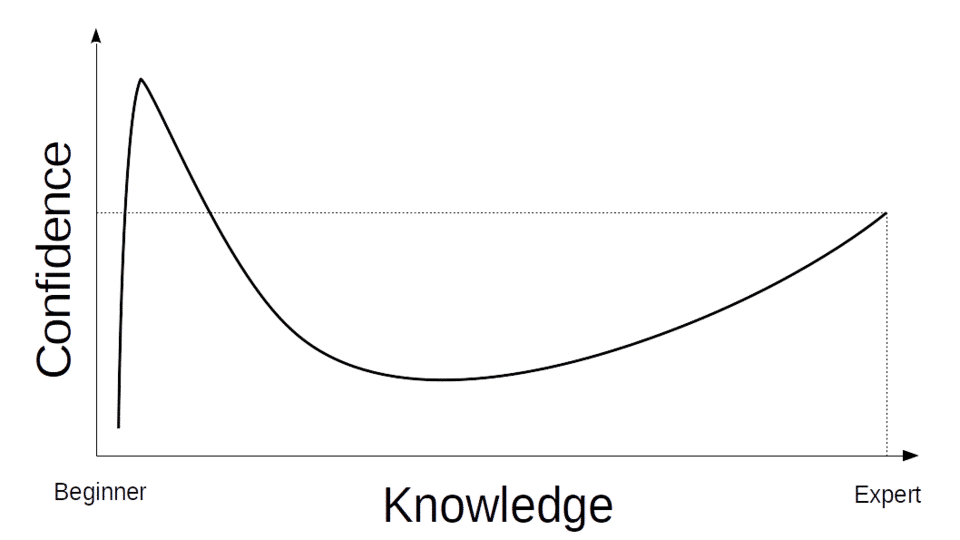
Dunning-Kruger Effect occurs when people with limited knowledge or skill in a specific area significantly overestimate their competence because the same abilities needed for good performance are required to recognize good performance, creating a dual burden of incompetence and poor self-awareness.
What if your strongest areas of confidence are actually your biggest blind spots? The Dunning-Kruger effect reveals why people who know the least often feel the most certain, while true experts question themselves constantly.
What is the Dunning-Kruger Effect?
The Dunning-Kruger effect is a cognitive bias where people with limited knowledge or skill in a particular area significantly overestimate their own competence. In simple terms, the less you know about something, the more likely you are to believe you’re good at it.
This phenomenon was named after David Dunning and Justin Kruger, two Cornell University psychologists who published their landmark study in 1999. Their research revealed something counterintuitive: the people who performed worst on tests of logic, grammar, and humor were also the most likely to inflate their own scores. Meanwhile, high performers tended to slightly underestimate themselves.
Why does this happen? Dunning and Kruger discovered a fascinating double burden. The same skills you need to produce a correct answer are the very skills you need to recognize what a correct answer looks like. When you lack expertise in an area, you also lack the tools to evaluate your own performance accurately. You don’t know what you don’t know.
The classic visualization of the Dunning-Kruger effect shows a distinctive pattern. Beginners often sit at “Mount Stupid,” a peak of confidence built on superficial understanding. As they learn more and encounter real complexity, confidence crashes into the “valley of despair.” From there, competence and confidence gradually climb together toward genuine expertise, where self-assessment finally aligns with reality.
This isn’t about intelligence or self-esteem. Highly intelligent people fall into this trap in areas outside their expertise, and people with low confidence can still overestimate specific skills. The Dunning-Kruger effect is specifically about a gap between actual ability and perceived ability, a blind spot created by inexperience itself.
The Original 1999 Study: Where the Research Began
The Dunning-Kruger effect was first identified at Cornell University in 1999, where psychologists David Dunning and Justin Kruger designed a series of experiments that would reshape how we understand self-assessment.
The researchers conducted four separate studies testing undergraduate students in three distinct areas: logical reasoning, grammar, and humor. After completing each test, participants estimated how well they performed compared to their peers. The results revealed a striking pattern.
Participants who scored in the bottom quartile overestimated their test performance by an average of 50 percentile points. Someone scoring in the 12th percentile, for example, might guess they landed around the 62nd. Meanwhile, top performers showed the opposite tendency, slightly underestimating their abilities. This asymmetry suggested something fundamental about how skill level shapes self-perception.
The original research provided compelling evidence, though the findings have sparked ongoing scientific discussion. The study’s methodology was straightforward: test people, ask them to predict their scores, and compare predictions to reality. The gap between actual and perceived performance among low scorers was consistent across all three skill domains.
Part of the study’s inspiration came from an unlikely source: a man named McArthur Wheeler, who robbed two Pittsburgh banks in broad daylight with no disguise. Wheeler believed that rubbing lemon juice on his face would make him invisible to security cameras. His confident incompetence caught Dunning’s attention and helped spark the research. The work earned an Ig Nobel Prize in 2000, an award celebrating research that first makes people laugh, then makes them think.
Why Incompetent People Rarely Know They’re Incompetent
The Dunning-Kruger effect reveals something fascinating about how our minds work. When someone lacks skill in a particular area, they’re missing more than just ability. They’re also missing the mental tools needed to spot their own gaps.
The Dual Burden of Incompetence
The core problem is this: the same skills you need to do something well are the exact same skills you need to recognize when it’s done well. A novice chess player can’t see why their strategy is flawed because understanding the flaw requires the strategic thinking they haven’t developed yet. A beginning writer struggles to identify weak prose because recognizing weak prose demands the same expertise as writing strong prose.
This creates what researchers call a “dual burden.” You’re not just performing poorly at the task. You’re also unaware that you’re performing poorly. The knowledge gap works double duty, limiting both your performance and your self-awareness simultaneously.
Metacognition Requires What You Don’t Have
Metacognition is the ability to think about your own thinking, to step back and evaluate your mental processes. It sounds simple, but it requires a foundation of knowledge to work properly.
When you’re a beginner, you lack the reference points that make accurate self-assessment possible. You’ve never seen true expertise up close, so you can’t measure yourself against it. Your mental map of the territory is incomplete, which means you don’t even know what you don’t know.
The Comfort of Not Knowing
Our minds also have built-in protection systems. Acknowledging incompetence feels threatening to our sense of self, so our brains find ways to avoid that discomfort. We dismiss feedback that challenges our self-image. We remember our successes more vividly than our failures.
Confirmation bias compounds this problem. Once we’ve decided we’re competent at something, we naturally seek out evidence that supports this belief while overlooking evidence that contradicts it. A person with poor public speaking skills might focus on the one audience member nodding along while ignoring the dozens checking their phones.
These psychological mechanisms aren’t character flaws. They’re normal human tendencies that affect everyone to some degree. Recognizing them in ourselves is the first step toward more accurate self-perception.
Real-World Examples of the Dunning-Kruger Effect
The Dunning-Kruger effect shows up in nearly every area of life. Once you know what to look for, you’ll start noticing it everywhere, including in yourself.
In the Workplace
New employees sometimes dismiss established processes before understanding why they exist. Fresh out of training, they might think, “This company has been doing it wrong for years.” While fresh perspectives can be valuable, this confidence often fades once they grasp the complexity behind seemingly inefficient systems.
First-time managers frequently overestimate their leadership abilities. Managing people looks straightforward from the outside: delegate tasks, give feedback, hit targets. The nuances of motivating different personalities, navigating conflicts, and balancing competing priorities only become apparent with experience. Many new leaders discover that what seemed like common sense requires skills they haven’t yet developed.
In Health and Financial Decisions
Few examples carry higher stakes than health decisions. Some patients spend hours researching symptoms online and arrive at appointments convinced they know their diagnosis. While being informed about your health is valuable, a few internet searches can’t replicate years of medical training and clinical experience. This overconfidence can lead people to dismiss professional advice or delay necessary treatment.
Financial decisions show similar patterns. Amateur investors who experience early wins in the stock market often attribute success to skill rather than luck or favorable conditions. This inflated confidence can lead to riskier bets and larger losses when market complexity eventually catches up with them.
In Everyday Life and Social Media
Scroll through any social platform and you’ll find confident takes on economics, psychology, politics, and science from people with surface-level exposure to these fields. A viral post or a single documentary can make someone feel like an expert.
The effect also appears in smaller moments. Most drivers rate themselves as above average, which is statistically impossible. DIY enthusiasts tackle plumbing or electrical work after watching one tutorial video. Friends offer relationship advice based solely on their own limited experience. These everyday examples remind us that overconfidence isn’t reserved for dramatic situations. It’s woven into ordinary life.
The Expertise Paradox: Why Knowing More Can Make You Less Confident
The more you learn about a subject, the less confident you might feel about your abilities. This explains why brilliant professionals often doubt themselves while less skilled individuals radiate unearned certainty.
True experts frequently underestimate their relative ability because they assume others share their knowledge. A seasoned software developer might think debugging code is straightforward, forgetting that it took years to develop that intuition. A skilled therapist might downplay their clinical insights, assuming any trained professional would reach the same conclusions.
This connects to what researchers call the “curse of knowledge.” Once you deeply understand something, it becomes nearly impossible to remember what it felt like not to understand it. You lose access to your own beginner’s mind, which makes your skills feel ordinary to you even when they’re exceptional.