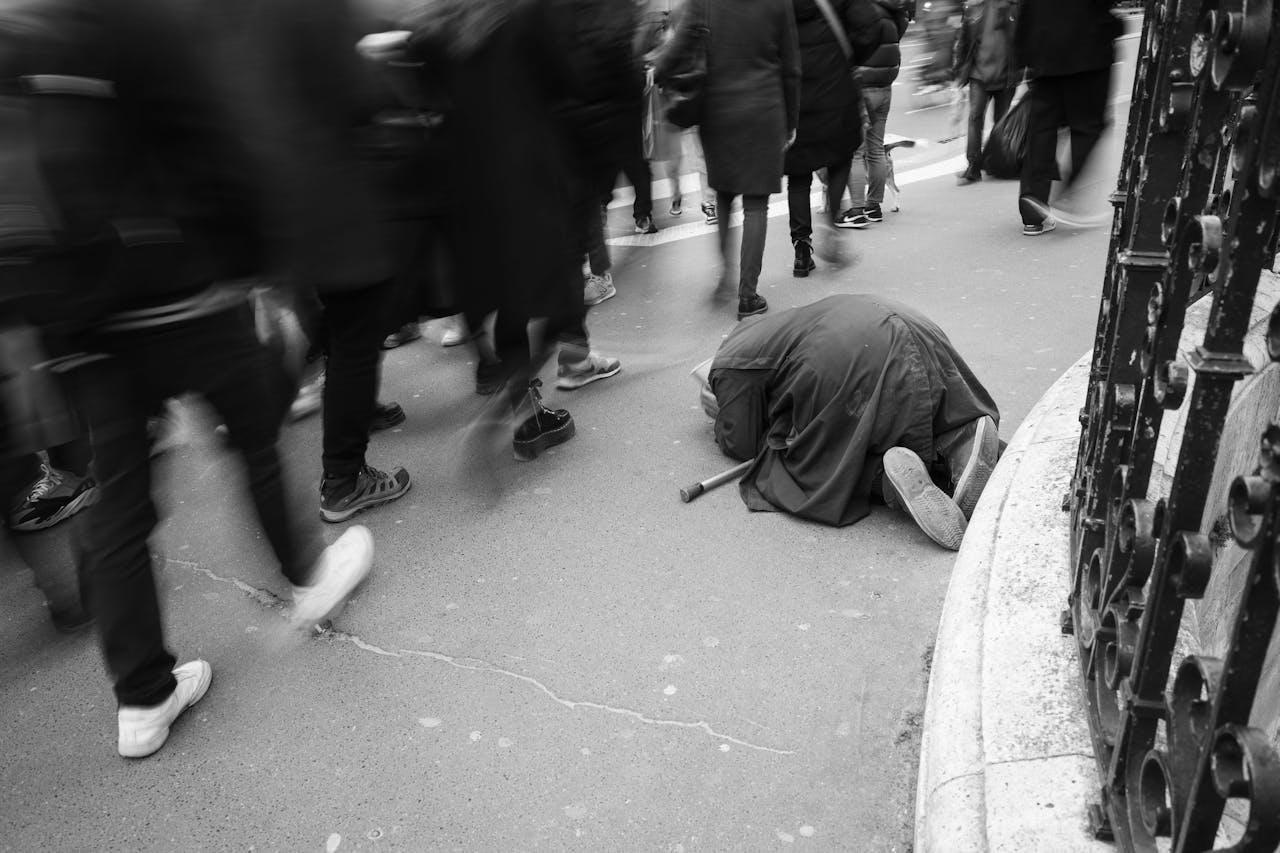
Bystander effect occurs when people are less likely to help someone in need when other witnesses are present, caused by diffusion of responsibility, pluralistic ignorance, and evaluation apprehension that can be overcome through specific intervention strategies and stress management techniques.
Have you ever seen someone in trouble and wanted to help, but found yourself frozen instead? The bystander effect reveals why good people freeze in emergencies - and it has nothing to do with not caring.
What is the bystander effect?
You see someone collapse on a busy sidewalk. Dozens of people walk past. You want to help, but something holds you back. Maybe someone else will step in. Maybe they already called 911. Maybe you’re misreading the situation.
This internal hesitation has a name: the bystander effect. It’s the psychological phenomenon where individuals are less likely to offer help when other people are present. The more witnesses to an emergency, the less likely any single person is to intervene.
What makes this phenomenon so striking is that it doesn’t stem from apathy or selfishness. Most people genuinely want to help others in distress. The bystander effect reveals something more uncomfortable: good intentions don’t always translate into action, especially when we’re surrounded by others who are also doing nothing.
Psychologists John Darley and Bibb Latané first documented this phenomenon in their foundational research following the 1964 murder of Kitty Genovese in New York City. Their 1968 experiments showed that participants who believed they were alone were far more likely to report an emergency than those who thought others were also aware of it. This research launched decades of study into why crowds can paradoxically reduce helping behavior.
A meta-analytic review of bystander intervention across multiple studies has confirmed that this effect persists across different types of emergencies and cultural contexts. It’s not a quirk of one experiment; it’s a consistent pattern in human behavior.
Understanding the bystander effect means recognizing a crucial distinction: being unwilling to help is very different from being psychologically inhibited from helping. Most bystanders aren’t cold or uncaring. They’re caught in a web of social and cognitive forces that create a gap between their desire to act and their actual behavior. The sections ahead will explain exactly why that gap exists and what creates it.
The Kitty Genovese case: what it really teaches us
On March 13, 1964, a 28-year-old woman named Kitty Genovese was murdered outside her apartment building in Queens, New York. Two weeks later, The New York Times published a front-page story that would change how we think about human behavior in emergencies. The article claimed that 38 witnesses watched or heard the attack unfold over more than half an hour, yet none of them called the police or intervened.
The story shocked the nation. How could so many people witness a brutal attack and do nothing? The case became a symbol of urban apathy, cold indifference, and moral failure. It sparked outrage, soul-searching, and eventually, scientific inquiry into why bystanders fail to act.
The story we were told versus what actually happened
Decades of investigative journalism and archival research have revealed that the original account was significantly exaggerated. The number 38 appears to have been inflated, and many of those counted as witnesses heard only fragments of what they assumed was a routine argument. Some couldn’t see the attack from their windows. At least one neighbor did call the police. Another woman held Genovese as she died.
The reality was messier and more human than the neat narrative of 38 silent witnesses. People were confused, uncertain about what they were hearing, and unsure whether police had already been contacted.
Why the case still matters
Even with these corrections, the Genovese case remains significant for two reasons. First, it reveals how powerful stories shape public understanding of complex social phenomena. The original narrative, though flawed, captured something real about the anxiety people feel regarding whether others will help in a crisis.
Second, and more importantly, the case inspired psychologists John Darley and Bibb Latané to investigate bystander behavior systematically. Rather than accepting the apathy explanation, they designed experiments to understand the psychological mechanisms at work. Their research revealed that the presence of others doesn’t simply reflect indifference. It actively changes how people perceive and respond to emergencies in predictable ways.
Why the bystander effect occurs: the psychology behind inaction
Understanding why people fail to help in emergencies requires looking at the invisible mental processes happening in real time. Researchers have identified a multi-step decision model that explains helping behavior. Before someone intervenes, they must first notice the event, interpret it as an emergency, feel personally responsible, know how to help, and then decide to act. A breakdown at any step can prevent intervention, and the presence of others creates obstacles at nearly every stage.
Three psychological mechanisms work together to create the bystander effect. Each one is powerful on its own, but when they operate simultaneously, they can paralyze even well-intentioned people.
Diffusion of responsibility
When you’re the only person witnessing someone in trouble, the responsibility to help falls squarely on you. But add more witnesses, and something shifts. That sense of personal obligation gets divided among everyone present, often leaving no one feeling truly responsible.
This is diffusion of responsibility in action. According to research on group size and helping behavior, the likelihood of intervention decreases as the number of bystanders increases. Each person assumes someone else will step up, someone more qualified, closer, or simply more willing.
Consider a busy subway platform where someone collapses. With dozens of people around, each witness might think: surely someone has already called for help. The result? Precious minutes pass while everyone waits for everyone else. Shared responsibility quietly becomes no one’s responsibility.
Pluralistic ignorance and social influence
One major way social factors influence the bystander effect is through pluralistic ignorance, a phenomenon where people look to others for cues about how to react, while those others are doing the exact same thing.
In ambiguous situations, we naturally check how people around us are responding. If no one seems alarmed, we assume there’s no real emergency. The problem is that everyone else is also staying calm because they’re watching you stay calm. A modern review of the bystander effect confirms that this social influence mechanism plays a significant role in suppressing helping behavior.
Consider a college lecture hall where a student slumps over their desk. Other students glance around, see no one reacting with urgency, and conclude the person must just be tired or resting. Meanwhile, the student could be experiencing a medical emergency. Everyone’s outward composure creates a false consensus that nothing is wrong.
Evaluation apprehension: the fear of acting wrong
Even when someone recognizes an emergency and feels responsible, another barrier often stops them: the fear of looking foolish. This evaluation apprehension makes people hesitate because they worry about being judged negatively by others.
What if I’m overreacting? What if I do something wrong and make things worse? What if people laugh at me? These questions race through a bystander’s mind, creating paralysis at the moment action is needed most.
Seeing someone lying motionless on a park bench, for example, might prompt worry that approaching them could be embarrassing if they’re simply sleeping. The fear of looking paranoid or intrusive leads people to walk past, telling themselves it’s probably nothing, while the person may desperately need help.
How these mechanisms reinforce each other
These three psychological forces rarely operate in isolation. They feed into one another, creating a powerful cycle of inaction. Diffusion of responsibility makes you less likely to feel obligated. Pluralistic ignorance convinces you the situation isn’t serious. Evaluation apprehension keeps you from breaking the social norm of non-intervention that everyone else seems to be following.
The result is a group of people who may genuinely want to help but find themselves frozen. Understanding these mechanisms is the first step toward overcoming them.
The intention-action gap: why your brain betrays your values
You see someone in trouble. You want to help. You know you should help. And yet, your feet stay planted. Your voice catches in your throat. Later, you replay the moment with confusion and shame, wondering why you didn’t act when your values clearly told you to.
This disconnect between intention and action isn’t a character flaw. It’s neurobiology. When you witness an emergency, your brain undergoes rapid changes that can temporarily override your conscious choices, no matter how strongly you believe in helping others.
The neuroscience of freezing
Your brain’s alarm system, the amygdala, doesn’t wait for your permission to respond to perceived threats. Within milliseconds of registering danger, it triggers a cascade of automatic responses that evolved to keep you alive. The freeze response is one of these survival mechanisms, and it’s far more common than most people realize.
When you encounter an emergency, your amygdala can interpret the situation as threatening to you, even when you’re technically safe. Research on reflex responses in bystander situations shows that automatic reactions play a significant role in whether people intervene. Your body may freeze before your conscious mind has finished processing what’s happening.
This freeze state served our ancestors well when predators lurked nearby. Staying still and quiet could mean survival. In modern emergencies where action is needed, this ancient wiring can work against us. Your prefrontal cortex, the part of your brain responsible for rational decision-making and planned action, essentially gets put on hold while your survival brain takes over.
Stress hormones and decision-making
The moment your amygdala sounds the alarm, your adrenal glands flood your system with cortisol and adrenaline. These stress hormones prepare your body for physical action: your heart rate increases, your muscles tense, and blood flow shifts away from your digestive system.
These same hormones suppress activity in your prefrontal cortex. The brain region you need most for assessing the situation, planning your response, and executing helpful action becomes less accessible precisely when you need it. Your ability to think clearly, weigh options, and make decisions becomes genuinely impaired under acute stress.
fMRI studies examining brain activity during bystander scenarios reveal this pattern clearly. When people view emergency situations, researchers observe heightened amygdala activation alongside reduced prefrontal engagement. The more threatening the scenario appears, the more pronounced this effect becomes.
This explains why your stated values and your behavior under pressure can diverge so dramatically. You might spend years believing you’d intervene in an emergency, only to find yourself paralyzed when one actually occurs. The gap isn’t hypocrisy. It’s the difference between how your brain functions during calm reflection versus acute stress.
Understanding this neurobiology matters because it shifts the conversation from moral judgment to practical preparation. Approaches like cognitive behavioral therapy can help people develop strategies for managing stress responses, while trauma-informed care offers support for those carrying guilt after their freeze response prevented them from helping. Recognizing that your brain, not your character, may have been responsible can be the first step toward self-compassion and growth.
Real-world examples of the bystander effect
The bystander effect shows up in countless situations, from dramatic emergencies to quiet everyday moments. Recognizing these patterns can help you understand why people freeze and how you might respond differently.
Emergency situations often reveal the starkest examples. On a crowded subway platform where someone collapses, dozens of people may glance around waiting for someone else to call for help or start CPR. Each person assumes another bystander must be more qualified or closer to the situation. The same dynamic plays out at car accidents, where drivers slow down but keep moving, expecting someone ahead has already dialed emergency services.
Workplace settings create their own version of bystander paralysis. When employees witness harassment, discrimination, or unethical behavior, many stay silent. Research on workplace bystander dynamics shows that professional environments add extra layers of hesitation: fear of career consequences, uncertainty about company protocols, and assumptions that HR or management will handle it.