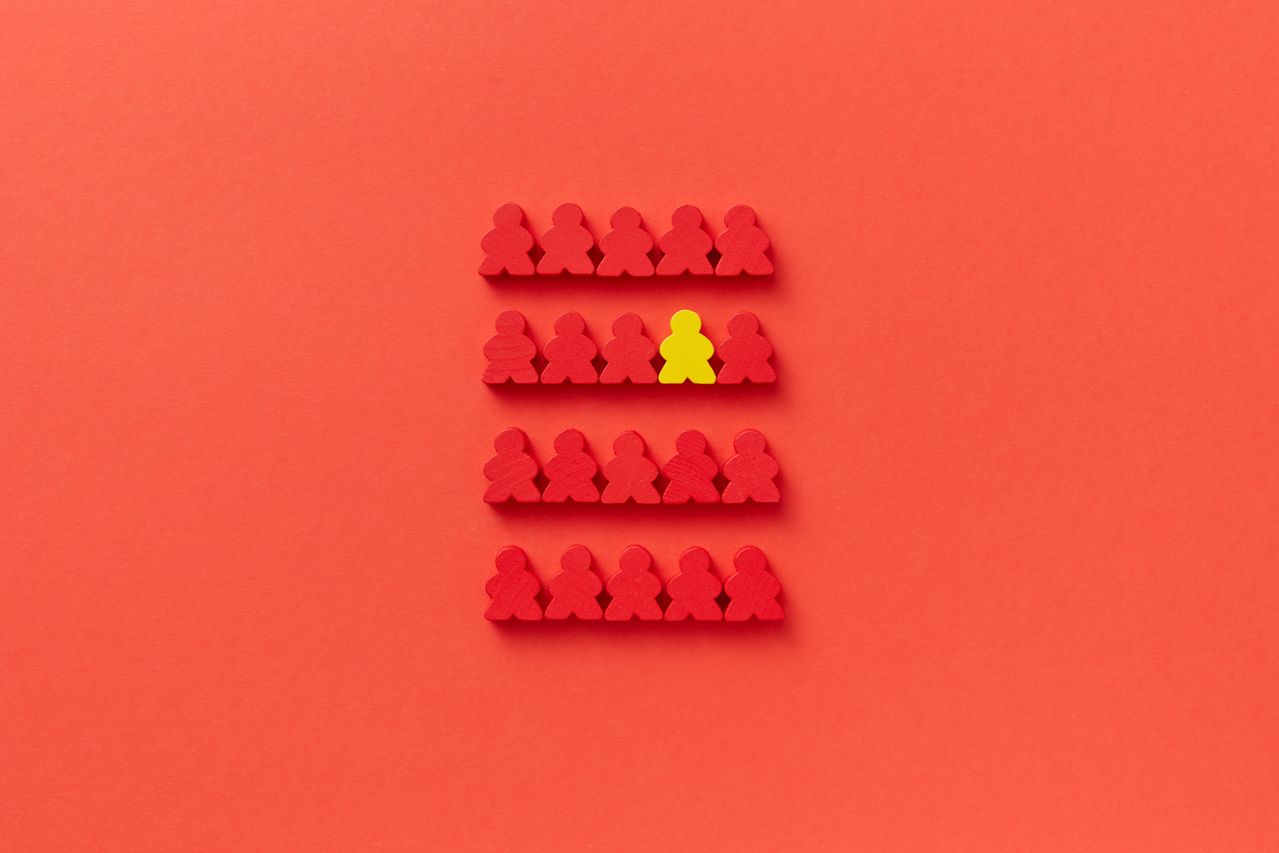
Koinophobia, the fear of living an ordinary life, is rooted in childhood conditioning, amygdala-driven threat responses, and cultural pressure from hustle culture and social media, and evidence-based therapies including ACT and CBT offer clinically grounded strategies to help individuals break free from achievement anxiety and find genuine meaning in everyday life.
Your brain treats being ordinary the same way it treats physical danger, and that's not a metaphor. The koinophobia driving your restless need to achieve isn't just ambition. It's a misfiring survival response, shaped by neuroscience, childhood conditioning, and a culture engineered to make average feel like failure.
What is the fear of being ordinary? (Koinophobia defined)
Some people don’t just want to succeed. They feel a deep, unsettling dread at the thought of being average. This fear has a name: koinophobia, derived from the Greek word koinos, meaning common or shared. It describes an intense fear of living an ordinary, unremarkable life, and it goes well beyond healthy ambition or a desire to grow.
Koinophobia exists on a spectrum. For some, it shows up as mild discomfort when a peer outperforms them or when life feels too routine. For others, it becomes a consuming force that quietly shapes every major decision, from career choices to relationships to how they measure their own worth on any given day.
Koinophobia is not a formal diagnosis in the DSM, the standard manual clinicians use to classify mental health conditions. It does, though, overlap significantly with well-documented psychological patterns, including perfectionism, low self-esteem rooted in contingent self-worth, and imposter syndrome, the nagging fear that your ordinariness will eventually be exposed. Research by Curran and Hill found that multidimensional perfectionism has risen sharply across generations, suggesting this fear isn’t a personal failing. It’s a pattern playing out across an entire culture.
If any of this feels familiar, you’re not alone, and you’re not broken.
Your brain on ‘average’: the neuroscience of why ordinariness feels like a threat
When you scroll past someone’s promotion announcement and feel a sudden, uncomfortable knot in your chest, that’s not just insecurity. That’s your brain’s alarm system doing exactly what it was built to do, just pointed in the wrong direction. Understanding the neuroscience behind this reaction can help explain why the pressure to be exceptional doesn’t just feel stressful. It feels existential.
The amygdala’s misfire
The amygdala is the brain’s threat-detection center, a small, almond-shaped structure that evolved to keep you alive in genuinely dangerous situations. The problem is that it doesn’t reliably distinguish between a physical threat and a social one. Research on the amygdala’s heightened threat-detection response shows that this region can become sensitized, firing the same neural alarm signals in response to perceived social demotion as it would for actual danger. Your brain, in other words, can treat feeling ordinary as a survival-level emergency.
The dopamine feedback loop
Layered on top of this is a dopamine problem. Dopamine is a neurotransmitter, a chemical messenger, associated with reward and motivation. Every time you received a gold star as a kid, a glowing performance review at work, or a rush of likes on a post, your brain logged that external validation as a high-value reward. Over time, this conditions the brain to seek approval as though it were a basic need, not a bonus. The cycle reinforces itself: you achieve, you receive praise, you feel relief, and then the baseline quietly shifts upward. Ordinary stops feeling neutral. It starts feeling like withdrawal.
How social media reshapes your baseline
Chronic exposure to algorithmically curated highlight reels compounds this further. Platforms are designed to surface peak moments, not average Tuesdays. With enough exposure, your brain recalibrates what a normal life looks like, anchoring expectations to an impossible standard that almost no one actually lives. What was once a perfectly good life begins to register as falling short.
The negativity bias gap
Your brain also carries a built-in negativity bias, a tendency to weight negative information more heavily than positive. This means that feeling average doesn’t just feel neutral. It actively feels like failure. The statistical reality, though, is that most meaningful human lives are, by definition, ordinary. Most people won’t be famous, won’t build empires, and won’t trend online. That’s not a deficit. It’s just math. The gap between what your brain perceives and what is actually true is where so much unnecessary suffering lives.
Why normal life feels scary: the root causes
The fear of being ordinary rarely appears out of nowhere. It gets built, layer by layer, through early experiences that teach you what makes you lovable, safe, and worth keeping around.
Childhood praise and conditional love
Many people who struggle with ordinariness anxiety grew up hearing some version of “you’re so special” or “you’re not like other kids.” On the surface, that sounds like a gift. When praise is tied to performance rather than presence, though, something quietly shifts. The child learns that love and approval are not guaranteed. They are earned. Research on contingent regard and conditional love shows that when caregivers make warmth conditional on achievement, children build their sense of self around being exceptional. Ordinary becomes not just undesirable but genuinely threatening, because ordinary might mean unloved. These early patterns can leave lasting psychological imprints, a reality explored further in the context of childhood trauma.
How attachment shapes the need to perform
When caregivers consistently prioritize achievement over emotional presence, children learn a specific and painful lesson: connection requires a performance. A parent who lights up at a trophy but seems distracted during an ordinary Tuesday afternoon sends a clear signal. Over time, the child internalizes that being enough means doing enough. This is closely tied to insecure attachment styles, where approval-seeking and fear of abandonment become the emotional defaults. The adult who came from that environment may not consciously remember learning this rule, but they live by it every day.
The comparison trap and social rank
Humans evolved to monitor their standing within groups. Social rank theory suggests this instinct once served survival: knowing where you stood helped you navigate resources, alliances, and threats. The problem is that modern life has weaponized this instinct at a scale our brains were never designed for. Social media, career metrics, and public recognition create a constant, ambient comparison loop with no finish line. The result is a nervous system that treats being average as a social danger signal, even when no real threat exists.
The belief you may not know you’re carrying
Deep beneath conscious awareness, many people operate from a core schema, a foundational belief, that equates ordinary with worthless. You may not think that explicitly. Notice, though, what happens when someone outperforms you, or when you spend a weekend doing nothing remarkable. The discomfort that surfaces is the schema speaking. Perfectionism often reinforces this. Researchers identify three subtypes: self-oriented perfectionism (demanding flawlessness from yourself), other-oriented perfectionism (expecting it from others), and socially prescribed perfectionism (believing others expect it from you). Each subtype fuels the fear of ordinariness in a slightly different way, but all three share the same root: the unexamined belief that being exceptional is not a choice, but a requirement.
The system that made you this way: hustle culture, algorithms, and the weaponization of ordinariness
This fear did not appear out of nowhere. It was built, carefully and incrementally, by cultural forces that profit from your dissatisfaction with yourself.
How the pressure escalated decade by decade
In the early 2000s, career advice centered on a deceptively simple idea: follow your passion. It sounded freeing, but it quietly attached your professional worth to your personal identity. By the 2010s, LinkedIn had turned your resume into a personal brand, Instagram had turned your lifestyle into content, and the gig economy had reframed ordinary employment as a failure of ambition. Then TikTok arrived, and suddenly a teenager monetizing a hobby in their bedroom became the new benchmark for what anyone, at any age, should be doing with their free time. Each decade didn’t just raise the bar. It moved the floor.
Why your feed makes extraordinary look ordinary
Algorithms do not show you a representative slice of human life. They show you the outliers: the 22-year-old founder, the fitness transformation, the side hustle that replaced a six-figure salary. Platforms reward engagement, and extraordinary outcomes generate more clicks than quiet, stable ones. The result is a deeply distorted sample. When you scroll, your brain registers exceptional achievement as the baseline, not the exception. Statistically, you are comparing your everyday reality to a curated highlight reel of the top fraction of a percent, and concluding that you are falling short.
The paradox that exhausts everyone
Here is where the system collapses under its own weight. As more people perform exceptionalism online, the performance itself becomes ordinary. Everyone has a personal brand. Everyone has a side hustle. Everyone is building something. The very behaviors meant to signal uniqueness have become so widespread that they no longer differentiate anyone. The race to stand out has produced a landscape where standing out is nearly impossible, yet the pressure to try has never been more intense. Research consistently links this kind of chronic achievement pressure to rising anxiety and burnout rates, particularly among Gen Z, who have grown up entirely inside this system.
The fear of being ordinary is not a flaw in your character. It is a predictable, almost logical response to an environment engineered to make ordinariness feel like defeat.
Signs the fear of being ordinary is affecting you
This fear rarely announces itself directly. Instead, it shows up in patterns you might have written off as personality quirks or ambition.
Behavioral signs tend to center on chronic goal-shifting. You start projects with intense energy, but the moment success starts feeling within reach, the goal suddenly seems too small. You abandon it and chase something bigger, leaving a trail of half-finished work behind. Committing to one path feels impossible because any single path feels like a ceiling.
Emotional signs are often the most disorienting. You might hit a milestone and feel nothing, or worse, feel hollow. A peer’s promotion can send you into a shame spiral even when your own life is objectively going well. There’s also a persistent anxiety that kicks in the moment you’re not being productive, as if stillness itself is dangerous. These anxiety symptoms are worth taking seriously because they signal that your nervous system has learned to treat rest as a threat.
Cognitive signs include all-or-nothing thinking about achievement: if you’re not extraordinary, you’re invisible. Intrusive thoughts about being forgotten or leaving no mark can surface without warning. Enjoying the present moment becomes difficult because ordinary moments don’t feel worth holding onto.
Somatic signs are what the body keeps score of. Chest tightness while scrolling social media, insomnia before or after big achievements, and a bone-deep exhaustion from constantly monitoring your own performance are all common physical expressions of this fear.