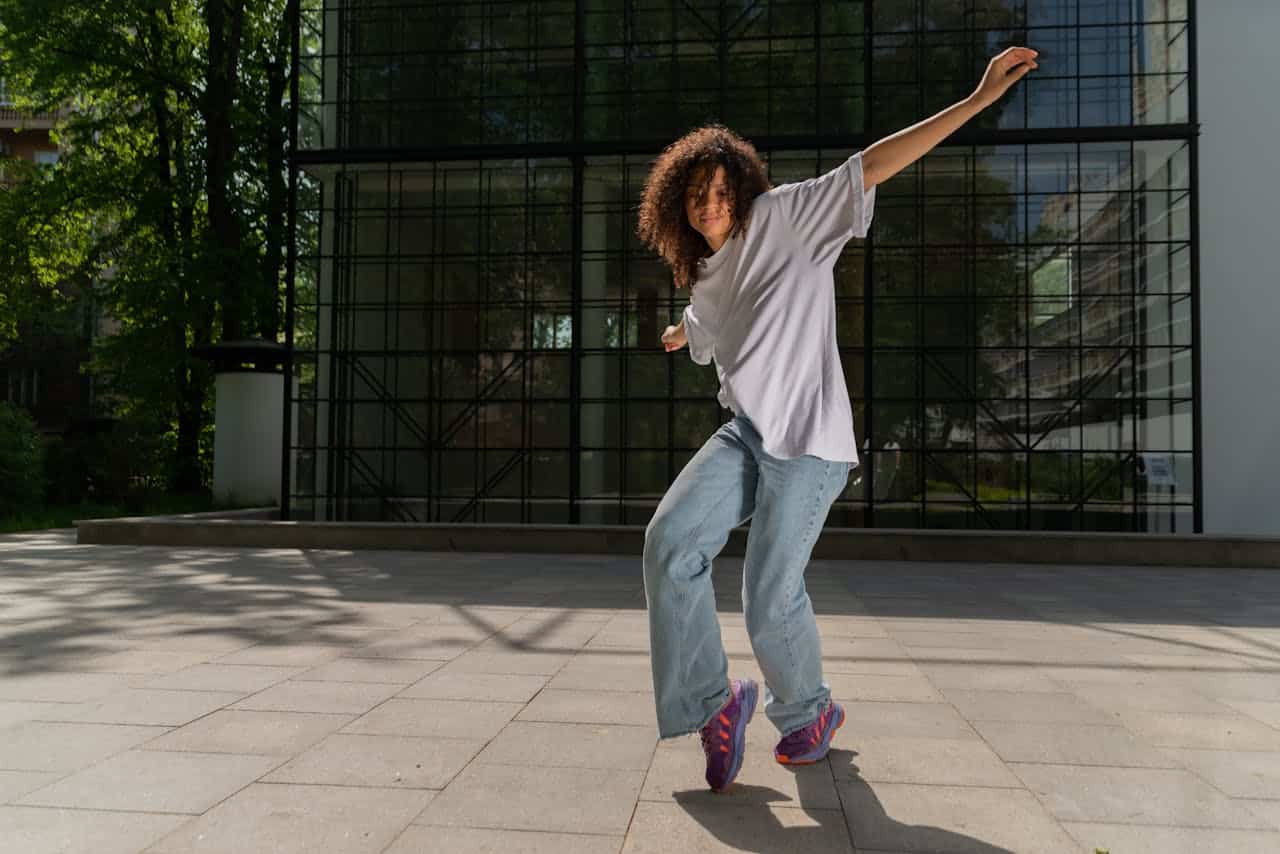
Dance movement therapy integrates guided movement with clinical psychotherapy to process trauma, anxiety, depression, and deeply-held emotions that words cannot reach, utilizing the scientifically-supported body-mind connection to facilitate comprehensive healing through licensed therapeutic practice.
What if the emotions you can't put into words are exactly what your body needs to express? Dance movement therapy offers a powerful way to process trauma, anxiety, and deep feelings through movement when traditional talk therapy feels incomplete or inadequate.
What is dance/movement therapy?
Dance/movement therapy (DMT) is a form of psychotherapy that uses movement as the primary way to support emotional, cognitive, physical, and social integration. According to the official definition from the American Dance Therapy Association, it’s rooted in the idea that body and mind are interconnected, meaning what you feel emotionally often shows up in how you move, and how you move can influence how you feel.
Unlike a dance class focused on technique or performance, DMT is a clinical practice led by credentialed professionals. Dance/movement therapists hold graduate-level degrees and earn credentials like BC-DMT (Board Certified Dance/Movement Therapist) or R-DMT (Registered Dance/Movement Therapist). These therapists are trained to observe movement patterns, understand nonverbal communication, and create safe spaces for expression and healing.
The approach emerged in the 1940s, largely thanks to Marian Chace, a dancer who began working with people experiencing psychiatric conditions. She noticed that movement could reach individuals when words couldn’t, opening pathways for connection and emotional release. Her work laid the foundation for DMT as a recognized therapeutic modality.
You don’t need any dance experience or skill to benefit from dance/movement therapy. Sessions focus on your natural movement impulses, whether that’s a gentle sway, a shift in posture, or a spontaneous gesture. The goal isn’t to perform or look a certain way. It’s about exploring how movement can help you process emotions, build awareness, and foster healing in a way that honors the connection between your body and mind.
This body-centered approach aligns with broader principles of trauma-informed care, recognizing that healing often requires engaging the whole person, not just thoughts or words.
What dance movement therapy is not: Dispelling common misconceptions
If you’re picturing a dance studio with mirrors, choreographed routines, and an instructor counting beats, that’s not dance movement therapy. Understanding what DMT isn’t can help you approach it with the right expectations and openness.
It’s not a dance class
Dance movement therapy doesn’t involve learning steps, perfecting technique, or memorizing choreography. You won’t be asked to master a waltz or nail a specific movement sequence. There’s no emphasis on doing movements “correctly” or looking graceful. The focus is entirely on what your movement communicates about your inner experience, not on the movement itself.
It’s not about aesthetics or performance
Your therapist isn’t evaluating whether you move beautifully or skillfully. There’s no judgment about flexibility, coordination, or how you look while moving. Unlike performance dance or even practices like mindfulness-based stress reduction that may involve mindful movement, DMT centers on the therapeutic relationship and what your body is expressing in the moment.
It’s not exercise therapy
While physical movement is central to DMT, the goal isn’t fitness, strength building, or cardiovascular health. A dance movement therapist observes your movement patterns to understand your emotional state, relationships, and psychological processes. They respond to what they see rather than instructing you through exercises. The therapeutic value comes from exploring how you move, what that movement means, and how shifting your movement can shift your emotional experience.
The neuroscience of movement and emotional processing
Your body remembers what your mind tries to forget. When you experience something overwhelming, your nervous system doesn’t just file it away as a memory you can talk about later. It encodes the experience in your muscles, your breathing patterns, and your automatic responses to the world around you. This is why dance movement therapy works on a fundamentally different level than traditional talk therapy alone.
The relationship between movement and emotional processing isn’t mystical or metaphorical. It’s rooted in how your brain and nervous system actually function.
The vagus nerve and nervous system regulation
The vagus nerve runs from your brainstem down through your body, connecting your brain to your heart, lungs, and digestive system. It’s the main component of your parasympathetic nervous system, which helps you feel safe and calm. Polyvagal theory, developed by researcher Stephen Porges, explains how this nerve acts like a surveillance system, constantly scanning for danger and safety cues in your environment.
When you perceive a threat, your vagus nerve triggers a cascade of physical responses: your heart races, your breathing becomes shallow, your muscles tense. You might recognize these as anxiety symptoms, but they’re actually your nervous system doing exactly what it evolved to do. The challenge comes when your system gets stuck in this threat response, even when the danger has passed.
Movement can directly influence your vagal tone, the measure of how well your vagus nerve regulates your nervous system. Rhythmic, intentional movement like swaying, rocking, or dancing signals safety to your nervous system in a way that thinking or talking about safety cannot. Your body shifts out of fight-or-flight mode not because you’ve reasoned your way out, but because the physical act of moving has changed your physiological state.
Why trauma lives in the body
Your brain stores memories in two fundamentally different ways. Explicit memory is what you can consciously recall and describe: what happened, when it happened, who was there. Implicit memory operates below conscious awareness, encoding experiences as bodily sensations, emotional reactions, and automatic behaviors.
When something traumatic happens, especially if it overwhelms your ability to process it in the moment, your brain often bypasses the explicit memory system entirely. The experience gets stored as implicit memory: a racing heart when you enter certain spaces, tension in your shoulders when someone raises their voice, or an inexplicable urge to flee during moments that should feel safe. You can’t necessarily remember or articulate what happened, but your body remembers.
This is what psychiatrist Bessel van der Kolk means when he describes how the body keeps the score. The traumatic experience isn’t just a difficult memory you need to reframe. It’s encoded in your nervous system’s threat detection mechanisms, your muscular holding patterns, and your automatic physical responses. Talking about the trauma engages your prefrontal cortex, the thinking part of your brain, but it doesn’t necessarily reach the deeper brain structures where these implicit memories live.
Dance movement therapy works with implicit memory directly. When you move in specific ways, you can access and begin to shift these stored patterns without needing to verbalize them first.
Bottom-up processing: Reaching what words cannot
Traditional talk therapy typically works top-down: you think about your experiences, analyze your patterns, and develop new perspectives through cognitive understanding. This approach engages your prefrontal cortex first, then hopes the insights will trickle down to change how you feel and behave. For many concerns, this works beautifully.
Bottom-up processing moves in the opposite direction. You start with bodily sensations, movements, and physical experiences, allowing emotional and cognitive insights to emerge from what you notice in your body. This approach directly engages the limbic system and brainstem, the more primitive parts of your brain that regulate emotion and survival responses, before involving the thinking brain.
The somatic marker hypothesis, proposed by neuroscientist Antonio Damasio, explains why this matters. Your body generates feelings in response to situations, and these bodily feelings guide your emotional responses and decisions, often before conscious thought enters the picture. When you feel your stomach drop or your chest tighten, that physical sensation is actually informing your emotional experience.
Psychologist Peter Levine’s work on somatic experiencing emphasizes that trauma isn’t just a mental event but an incomplete physiological response. When your body couldn’t complete its natural fight-or-flight response during a traumatic event, that incomplete activation remains in your nervous system. Movement provides a way to complete these arrested responses, releasing the stored energy and allowing your system to return to regulation.
How therapists read movement: Understanding Laban Movement Analysis
When you walk into a dance movement therapy session, your therapist isn’t just watching what you do. They’re observing how you move, reading the subtle qualities that reveal your inner emotional landscape. This specialized observation relies on a system called Laban Movement Analysis, a framework developed by Rudolf Laban that serves as the foundational language therapists use to decode the psychological meaning embedded in physical expression.
Laban identified four motion factors that describe the essential qualities of any movement. Weight ranges from light (like a feather floating) to strong (like pushing a heavy door). Time spans from sudden (a quick startle) to sustained (slowly reaching for something). Space moves from indirect (meandering, multi-focused) to direct (laser-focused on a target). Flow exists on a spectrum from free (uncontrolled, released) to bound (controlled, restrained). These aren’t just technical descriptions. They’re windows into how someone relates to their world and manages their emotions.
These four factors combine to create what Laban called Efforts, eight distinct movement qualities that carry specific psychological correlates. A person moving with bound flow, sudden time, and strong weight might be experiencing high anxiety or hypervigilance. Someone using light weight with indirect space could be dissociating or avoiding emotional contact. Sustained time with direct space often appears when someone feels grounded and intentional. Your therapist tracks these patterns, noticing when your shoulders tense (bound flow) or when your gestures become tentative (light weight).
This observational skill allows therapists to understand your emotional state without you saying a word. If you’re struggling to articulate what you’re feeling, your movement quality speaks volumes. A dance movement therapist might notice that you consistently move with sudden, bound qualities and gently bring this awareness to your attention. This observation isn’t judgment. It’s information.
The real power emerges when you become aware of your own movement patterns. Recognizing that you hold your breath and restrict your gestures when anxious gives you something tangible to work with. You can experiment with releasing that bound flow, allowing freer movement, and notice how your emotional state shifts in response. This body-based awareness becomes a practical tool for emotional regulation and self-understanding that extends far beyond the therapy room.
How dance movement therapy helps process trauma
Trauma lives in the body as much as it does in the mind. When you experience something overwhelming, your nervous system may freeze or shut down, leaving incomplete defensive responses trapped in your muscles and tissues. Dance movement therapy offers a way to access and process these stored experiences through movement, particularly when traditional talk therapy feels inadequate or incomplete.
When words are not enough
Many people find that talking about trauma only takes them so far. You might describe what happened clearly but still feel stuck, numb, or unable to move forward. This happens because traumatic memories often form before language develops or bypass the verbal processing centers of your brain entirely. The body remembers what words cannot capture.
Dance movement therapy works directly with these nonverbal memories. Instead of trying to explain what you felt, you explore sensations, impulses, and movements that arise naturally. A clenched jaw, a collapsed chest, or an impulse to push away all carry meaning that emerges through movement rather than narration. Your therapist helps you notice these patterns and explore them safely, creating space for expression that doesn’t depend on finding the right words.
Authentic movement: Working with the unconscious
Authentic Movement is a specific practice within dance movement therapy that creates a container for unconscious material to surface. In this approach, you become the “mover” while your therapist acts as a compassionate “witness.” You close your eyes and allow your body to move however it wants, following internal impulses rather than external choreography.
This witness-mover structure provides safety for vulnerable exploration. Your therapist holds space without judgment or interpretation, simply observing with full attention. You might find yourself curling into a ball, reaching upward, or moving in ways that surprise you. These spontaneous movements often reveal emotional truths or body memories that conscious thought keeps hidden. After moving, you and your therapist discuss what emerged, integrating the physical experience with verbal reflection.
Completing the body’s unfinished responses
When trauma occurs, your body prepares to fight or flee. If neither response is possible, that survival energy gets trapped. You might still carry the tension of a punch you never threw or a sprint you never completed. Dance movement therapy helps you identify and complete these interrupted responses in a safe, controlled environment.
Your therapist might guide you to explore pushing movements if you felt powerless, or running in place if you couldn’t escape. These aren’t reenactments of trauma but rather opportunities to discharge stored energy and restore a sense of agency. Repetitive movements can be particularly powerful, allowing your nervous system to release what it’s been holding. As you complete these responses physically, you often experience emotional shifts: relief, grief, anger, or unexpected calm.
This body-based processing complements verbal therapy for traumatic disorders. You might notice that after moving through a frozen response, you can finally talk about what happened with less distress. The integration of movement and words helps your whole system process and metabolize trauma, rather than just understanding it intellectually.