Childhood trauma hypervigilance, the nervous system adaptation that lets people read a room before they enter it, develops when chronic stress or unpredictable caregiving locks a child's threat baseline too high, leaving adults scanning for danger in safe situations, but evidence-based therapies including EMDR, CBT, and somatic experiencing help recalibrate the response with professional support.
Reading a room before you enter it isn't a social skill. It's hypervigilance, a survival strategy your nervous system built during childhood to keep you one step ahead of danger. This article explains why it developed, how it quietly shapes your adult life, and what healing can actually look like.
How growing up in chaos wires a hypervigilant nervous system
The brain does most of its foundational wiring during childhood, and it doesn’t wire itself in a vacuum. It organizes itself around the environment it lives in. When that environment is unpredictable, threatening, or emotionally unsafe, the developing brain does something remarkably intelligent: it builds a nervous system calibrated for danger. This is the core mechanism behind childhood trauma and hypervigilance, and understanding it helps explain why so many adults feel perpetually on edge even when their lives are, by most measures, safe.
At the center of this process is the HPA axis, short for the hypothalamic-pituitary-adrenal axis, which is the body’s primary stress-response system. In children who face chronic stress, the HPA axis stays activated for long stretches, keeping cortisol (the body’s main stress hormone) elevated. Over time, this reshapes the brain in measurable ways. The amygdala, the region responsible for detecting threats, grows larger and more reactive. The prefrontal cortex, which regulates emotional responses and helps assess whether a threat is real, becomes thinner and less effective. The result is a brain that is faster to sound the alarm and slower to turn it off.
The childhood environments that produce this kind of nervous system dysregulation are more varied than most people assume. Volatile or unpredictable caregivers are the most recognized cause, but emotional neglect, parentification (being placed in a caretaking role as a child), witnessing domestic conflict, chronic illness in the household, and poverty-driven instability all register as threat in a developing nervous system. The CDC’s research on adverse childhood experiences confirms that these environments are widespread and carry lasting effects on health and behavior well into adulthood.
Here is what matters most: the child who developed hypervigilance was not broken. They were adaptive. Scanning for shifts in a parent’s mood, reading tension in a room before anyone spoke, staying one step ahead of conflict — these were intelligent survival strategies. The problem is not the adaptation itself. The problem is that the nervous system doesn’t automatically update when the environment changes.
This is where the concept of a threat baseline becomes useful. Think of it as the nervous system’s default setting for how much danger exists at any given moment. In people who grew up in chaotic or unsafe environments, that baseline is set too high. Even in calm, low-risk situations, the internal alarm is already partially triggered, which is why childhood trauma hypervigilance so often follows people straight into adulthood.
Signs you grew up hypervigilant
Hypervigilance symptoms rarely look the way people expect. There’s no dramatic tell, no obvious sign. Instead, the signs of hypervigilance are woven into the texture of everyday behavior, so normalized by years of practice that they feel like personality traits rather than survival adaptations. Qualitative research on hypervigilance as a lived experience of chronic threat confirms that these patterns, including constant threat scanning, spatial caution, and social withdrawal, show up as concrete, consistent behaviors rather than abstract feelings of anxiety. If several of the following sound familiar, you’re not imagining it.
You read faces before you read words. Monitoring microexpressions, the flicker of tension around someone’s eyes, the slight tightening of a jaw, happens automatically and fast. You learned to do this because a caregiver’s mood once determined what kind of afternoon you were going to have. Reading the room before you entered it wasn’t a social skill. It was a safety skill. This kind of attunement is also deeply connected to attachment styles formed early in life, particularly insecure or disorganized attachment patterns where a caregiver was both a source of comfort and a source of threat.
You manage space deliberately. You sit facing the door in restaurants. You position yourself with your back to the wall in crowded rooms. You clock the exits. None of this feels like a choice, because it isn’t, not consciously. It’s your nervous system doing spatial threat management on autopilot.
You rehearse and pre-script. Before a difficult conversation, you’ve already run it seventeen times in your head, including the version where it goes badly and you need an exit strategy. Over-preparation that looks like diligence from the outside is often catastrophizing in disguise. The presentation has 40 backup slides because unpredictability once meant danger.
You sense tension between other people before they do. This is triangulated emotional surveillance: scanning not just for threats directed at you, but for shifts in the emotional field around you. You feel the friction between two colleagues before either of them has said a word.
You fawn. Psychologist Pete Walker coined the term « fawn response » to describe what happens when a person experiencing hypervigilance reads a room and then preemptively appeases to neutralize a perceived threat. What others call people-pleasing is actually a sophisticated survival strategy: scan, assess, and neutralize before anything escalates. It worked once. Now it runs in the background constantly.
You startle disproportionately. Someone drops a mug in the kitchen and your heart rate spikes as though a real threat appeared. Your body’s alarm system is calibrated to a threat level that no longer exists in your current environment.
You can’t fully relax, even when you’re safe. This is perhaps the most exhausting sign of all. Your nervous system doesn’t yet accept the concept of a safe environment. It keeps scanning, just in case, because once upon a time, letting your guard down had consequences.
Why you can read a room before you enter it: the neuroscience of neuroception
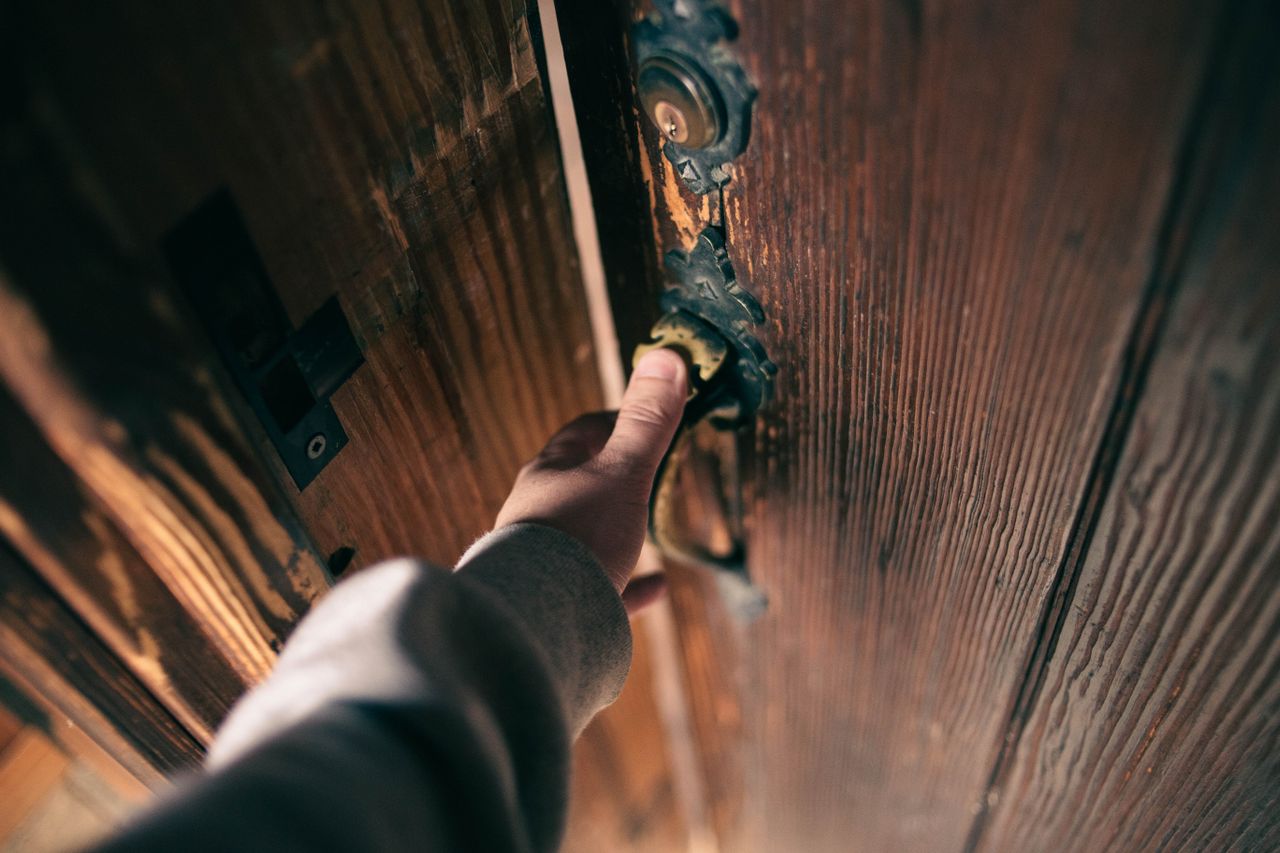
You pause outside a closed door. Something feels off. The voices on the other side sound normal, the words are indistinct, and you have not seen a single face yet. But your stomach has already tightened, your shoulders have already risen, and some part of you has already decided. This is not intuition in the mystical sense. This is your nervous system doing exactly what it was trained to do, faster than your conscious mind can keep up.
The mechanism behind this experience has a name: neuroception. Psychiatrist and neuroscientist Stephen Porges coined the term to describe the nervous system’s continuous, subconscious process of scanning the environment for safety or threat. Neuroception operates entirely below conscious awareness. It is not a thought, a feeling, or a decision. It is a biological process that evaluates risk before your brain has assembled a single coherent sentence about what is happening.
The sensory stack your brain runs before you open the door
Neuroception does not rely on one sense. It runs a full stack of inputs simultaneously. The vagus nerve (the long nerve connecting your brain to your heart, lungs, and gut) processes vocal tone and rhythm through walls before you see a single face. Your peripheral vision, operating at the edges of your visual field, picks up postural asymmetry in bodies across a room before your central vision has focused. Your olfactory system detects stress-related chemical cues, because stress has a measurable smell, and your amygdala registers those signals before conscious recognition occurs. Your interoceptive system, which reads signals from inside your own body, reports a gut tightening or a chest contraction before your eyes have confirmed anything.
All of this happens in milliseconds. The subcortical pathway, from thalamus to amygdala, processes threat signals at extraordinary speed. The cortical pathway, the one that produces conscious thought, takes longer. This is the biological reason you know before you know.
Polyvagal theory and the hypervigilant default
Polyvagal theory, also developed by Porges, describes the vagus nerve as a bidirectional information highway between the body and the brain. The theory identifies three primary states the nervous system moves between: ventral vagal (the state of safety, social engagement, and calm), sympathetic activation (fight-or-flight, mobilization, alertness), and dorsal vagal (shutdown, collapse, dissociation).
For most people, the nervous system moves fluidly between these states depending on context. For adults who grew up in high-threat environments, the system gets calibrated differently. The sympathetic state becomes the default. The baseline is activation, not rest. Your nervous system does not wait for a threat to appear. It assumes one is coming.
This is where polyvagal theory and hypervigilance become clinically meaningful. The system is not broken. It is optimized for a specific environment, one that no longer exists.
The calibration problem
Your neuroception is not wrong. It is detecting real signals. Vocal prosody, postural tension, olfactory stress cues, these are genuine pieces of environmental information that most nervous systems quietly discard. Yours does not discard them. Yours files them, weighs them, and responds.
The problem is calibration, not capability. A nervous system trained on a high-threat dataset learns to weight neutral cues as potentially dangerous. A colleague’s flat tone becomes a warning. A quiet room becomes suspicious. The radar is exquisitely sensitive, but the threshold for alarm is set far too low for ordinary life. Your nervous system is genuinely processing information that most people’s systems filter out. The issue is not that your radar works. The issue is that the radar never turns off.
How hypervigilance affects your adult life
Growing up in an environment where you had to stay alert to survive doesn’t just shape your childhood. It rewires the way you move through every room, relationship, and workday as an adult. The costs of an always-on threat detection system show up across nearly every domain of life, and they compound quietly over time.
Relationships and trust
Hypervigilance in relationships creates a painful paradox: you desperately want closeness, but closeness feels dangerous. You may pull back before someone gets the chance to hurt you, reading a delayed text or a neutral expression as early signs of abandonment. Partners often feel the weight of this. No matter how much reassurance they offer, it rarely lands for long, because the threat system resets quickly.
One of the stranger effects of hypervigilance is being drawn to chaotic or unpredictable relationships. Calm, stable partners can actually feel suspicious. Your nervous system learned that quiet often precedes danger, so peace registers as something to distrust rather than enjoy. Recognizing this pattern is the first step toward interrupting it.
Emotional and physical exhaustion
When all your attention is directed outward, scanning for threat, there’s very little left to direct inward. Many people with a hypervigilant history struggle to name what they’re feeling in a given moment. This is sometimes called alexithymia (difficulty identifying and describing emotions), and it makes sense: you were never trained to check in with yourself because checking in with your environment was the priority.
The physical toll is just as real. Chronic muscle tension in the jaw, shoulders, and lower back is common, as is disrupted sleep from a nervous system that never fully downregulates. Sustained cortisol suppresses immune function and contributes to headaches, digestive problems, and fatigue. Research on hypervigilance and elevated blood pressure supports what many people with this history already feel in their bodies: the threat response isn’t just psychological. It has measurable physiological consequences. Shame about being « too sensitive » or « too much » layers on top of all of this, making it harder to seek support.

